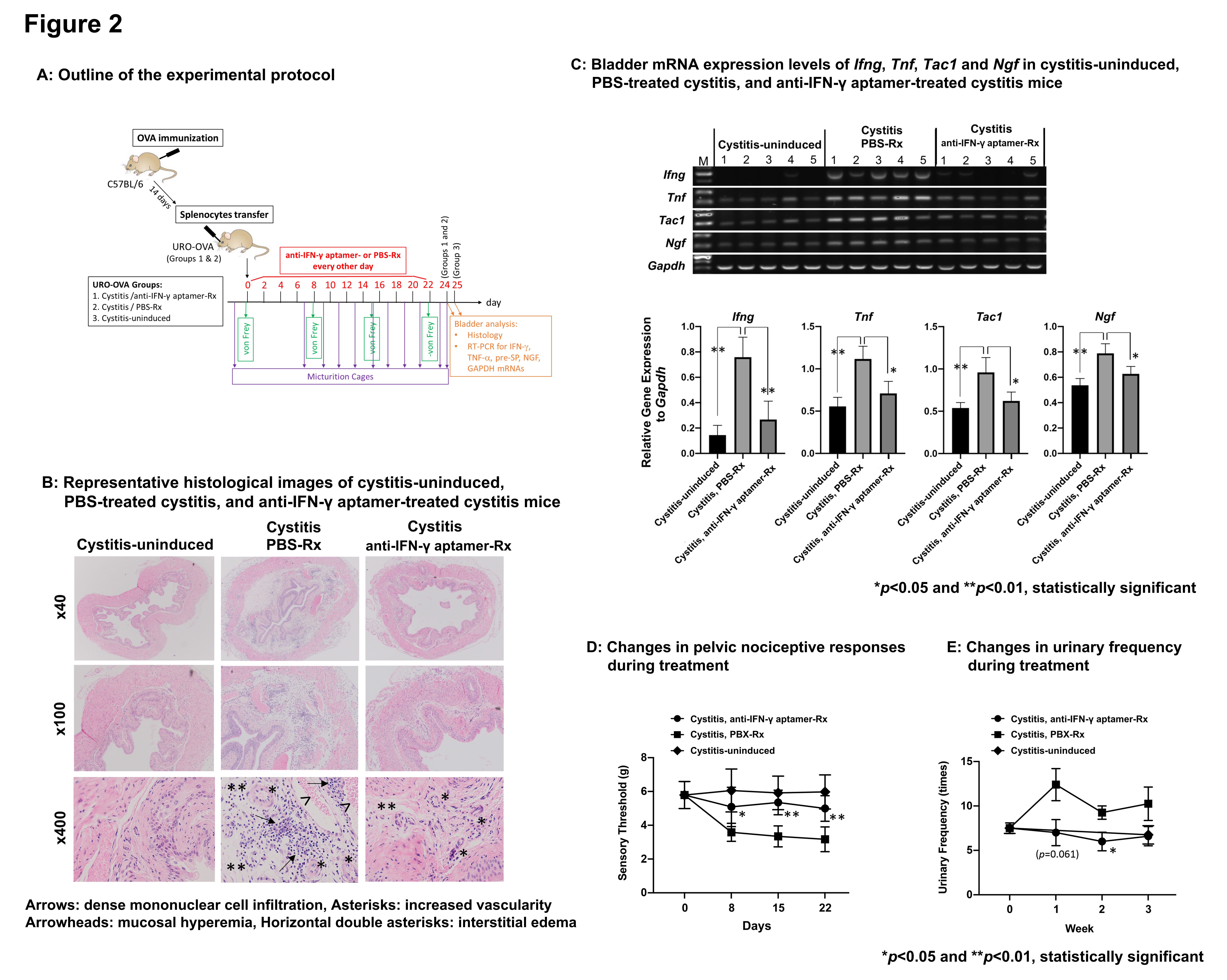
Introduction: To characterize unique cellular and immunological features of Hunner-type interstitial cystitis (HIC) relative to clinicopathologically similar bacillus Calmette–Guérin (BCG) cystitis, which might lead to potential therapeutic targets for treatment of HIC. Methods: Mucosal bladder biopsies, obtained from patients with HIC (n=25) and BCG cystitis (n=13), were subjected to RNA sequencing, immunohistochemistry, and quantitative polymerase chain reaction analyses for immune cell type markers and key mediators of innate/adaptive immune responses at mRNA and /or protein levels. A mouse anti-IFN-? aptamer, a synthetic oligo DNA sequence, was selected using the SELEX method and tested for therapeutic efficacy in a murine model of HIC which was established based on our previously developed transgenic URO-OVA mice. Results: RNA sequencing identified 3,682 differentially expressed genes and 175 significantly enriched biological pathways specific to HIC, featured by upregulation of T helper (Th) 1/17-related signaling pathways, B cell-related signaling pathway, and cytosolic DNA–sensing pathway. Compared to BCG cystitis, HIC also expressed increased mRNA levels of genes involved in Th1/17-meidated immune responses, including TBX21 (a Th1 cell signature molecule), RORC (a Th17 cell signature molecule), IFNG and IL17A, as well as overexpressed IFN-? and IL-17A proteins in the bladder (Figure 1). Intravesical instillation of the anti-IFN-? aptamer significantly ameliorated bladder inflammation, pelvic nociception and voiding dysfunction in a HIC mouse model (Figure 2). Conclusions: Th1/17-polarization highlighted by overexpression of IFN-? characterizes the HIC. Intravesical instillation of an anti-IFN-? DNA aptamer is potentially useful in the treatment of human HIC. SOURCE OF Funding: This study was financially supported by the KAKENHI Grants-in-Aid from the Japanese Society for the Promotion of Science (JSPS) [grant number 22K16788] (to YA), the Japan Agency for Medical Research and Development (AMED) [JP22nk0101220] (to SM), and the National Institute of Diabetes and Digestive and Kidney Diseases Grants R01-DK-111396 (to Y. Luo).