Session: PD05: Infections/Inflammation/Cystic Disease of the Genitourinary Tract: Interstitial Cystitis
PD05-11: Serum Anandamide and Lipids Associated with Linoleic Acid Can Distinguish Interstitial Cystitis and Bladder Pain Syndrome from Overactive Bladder
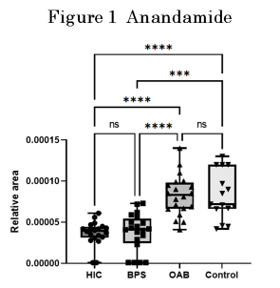
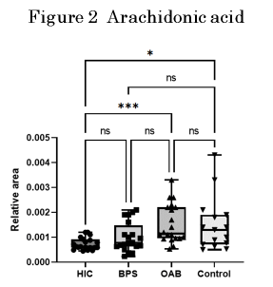
Introduction: Interstitial cystitis/bladder pain syndrome (IC/BPS) is challenging to diagnose because it relies on subjective symptoms and empirical cystoscopic findings. We performed metabolomics on the serum of participants with IC/BPS and without lower urinary tract symptoms (LUTS), and identified serum 1-linoleoyl-glycero-phosphocholine as a candidate diagnostic biomarker of Hunner type IC (HIC). However, in a subsequent study, the serum levels were found to be lower in HIC, BPS, and overactive bladder (OAB) than in those without LUTS. Therefore, we performed the second metabolomics on the serum of these four groups to identify better biomarkers. Methods: We enrolled participants with HIC (n = 20), BPS (n = 20), OAB (n = 20), and without LUTS (n = 15). Patients with BPS showed mucosal bleeding after distension. Metabolomics was performed on 323 metabolites in serum using liquid chromatography-mass spectrometry. Results: Partial least squares discriminant analysis revealed that the relative areas including anandamide, acylcarnitine (18:2) and linoleoyl ethanolamide, arachidonic acid were smaller in the groups with HIC or BPS than those with OAB or without LUTS. The difference in the relative areas of anandamide was remarkable, and the ability to discriminate IC/BPS exhibited an area under the curve of 0.9321, a sensitivity of 80.00%, and a specificity of 88.57%. Conclusions: Serum anandamide may be the best candidate as a diagnostic biomarker for IC/BPS. Low serum anandamide levels might be associated with the initiation of pain and inflammation, and may reflect the pathology of IC/BPS. The major candidates are linoleic acid metabolites or have linoleic acid in their side chains. This suggests the involvement of abnormal metabolism of linoleic acid in the pathogenesis of IC/BPS. SOURCE OF Funding: None