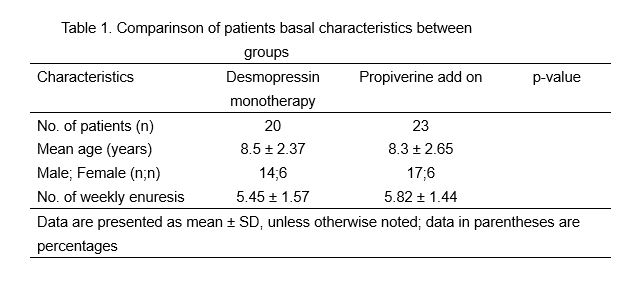
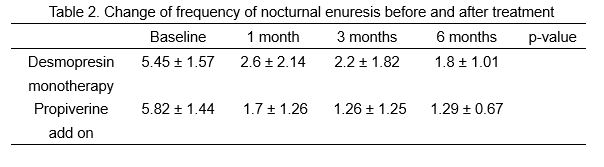
Introduction: We evaluated the efficacy of a combination treatment of desmopressin and propiverine for treating children with monosymptomatic primary nocturnal enuresis. Methods: A total of 53 children aged 6 to 15 years old with monosymptomatic nocturnal enuresis prospectively were enrolled in this study. Children with a minimum of 3 wet nights weekly were included in the study. Children were randomly assigned groups and treated with desmopressin 0.2mg, or a combination of desmopressin plus propiverine 10mg. Of these patients 43 (31 boys and 12 girls, mean age 8.4±2.5 years, range 4 to 13) were followed for more than 6 months. Efficacy was measured at 1, 3 and 6 months in terms of average enuretic frequency after treatment. Results: Of the 43 children finally analysed 23 received combination therapy of desmopressin and propiverine and 20 received desmopressin alone. The frequency of nocturnal enuresis at baseline in monotherapy group and combination therapy was similar (5.45±1.57 vs 5.82±1.44). However, decrease of the nocturnal enuresis was significantly pronounced in combination group after 6 months treatment than in monotherpy group (1.8±1.01 vs 1.29±0.67). Combination therapy produced better outcomes than monotherapy in terms of number of nocturnal enuresis episode. The adverse event was minimal. Conclusions: Combination therapy with desmopressin plus propiverine for the treatment of monosymptomatic nocturnal enuresis was well tolerated, and gave significantly effective results in reducing enuresis episode than single therapy of desmopressin in children. SOURCE OF Funding: None