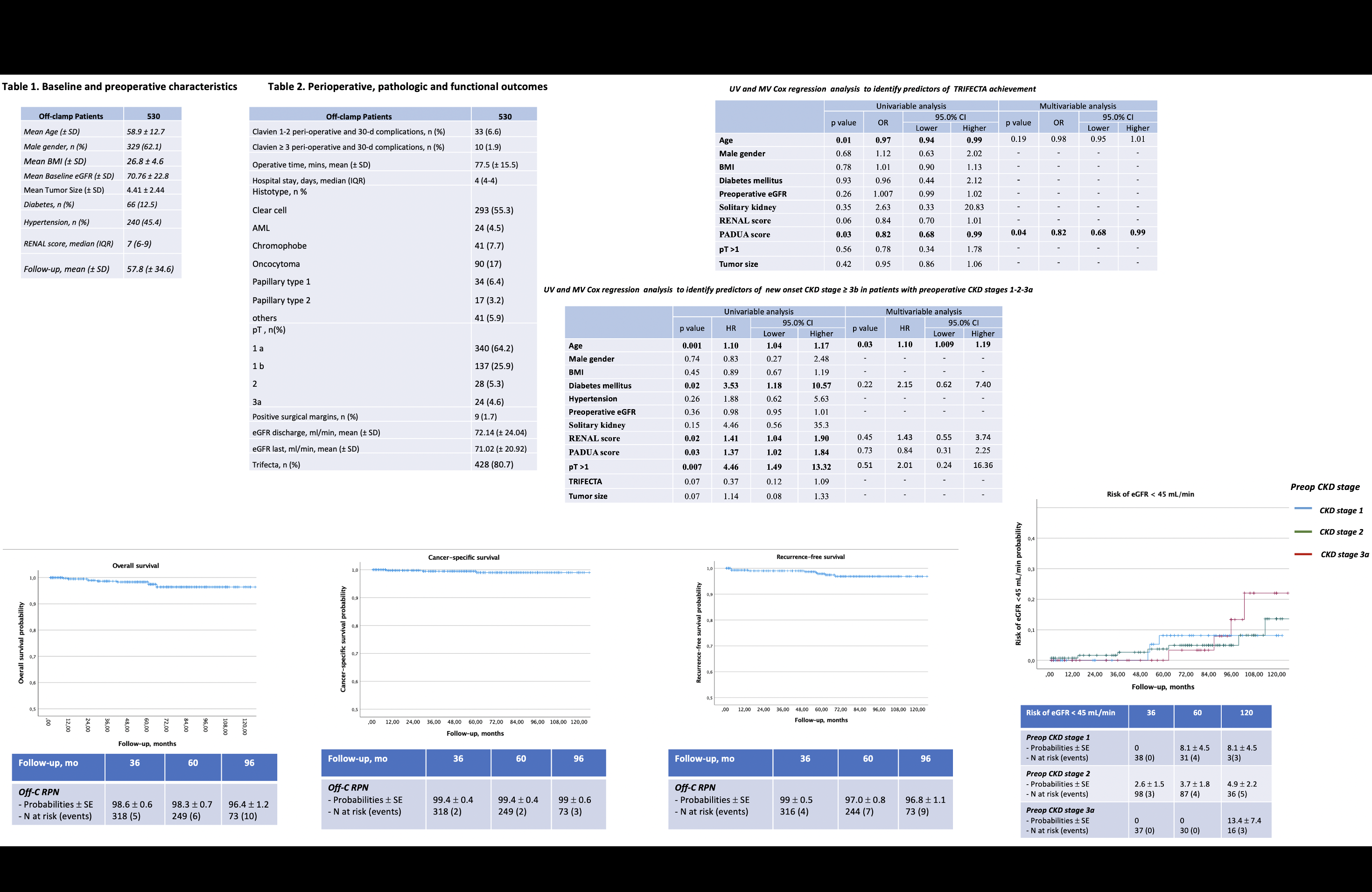
Introduction: The adoption of Off-clamp (Off-C) robotic partial nephrectomy (RPN) is led by the intent to maximize renal functional preservation. There is paucity of evidences about long-term functional outcomes of Off-c RPN. The aim of this study was to report peri-operative, and long term functional and survival outcomes of a single high-volume center series of Off-C RPN. Methods: A prospective renal cancer institutional database was queried, and data of consecutive patients treated with Off-C RPN between 2010 and 2015 in a high-volume center were collected. Baseline, preoperative, perioperative, oncological and functional outcomes were assessed. Trifecta was defined as the coexistence of negative margins, no Clavien-Dindo =3 complications and =30% postoperative estimated glomerular filtration rate reduction. Kaplan-Meier analysis was performed to assess survival and renal functional outcomes. Univariable and multivariable analyses were carried out to identify predictors of Trifecta achievement and renal function deterioration over time. Results: Overall, 530 patients with a mean follow-up of 57.8 months were included. Severe perioperative complications occured in 1.9% of patients. Trifecta was achieved in 80.9% of cases. The 8-year recurrence-free survival, cancer-specific survival and overall survival rates were 96.8%, 99% and 96.4%, respectively. Patients with baseline eGFR =60 ml/min displayed a negligible risk of long term severe renal function deterioration (10-yr newly onset Chronic kidney disease (CKD) stage 3b risk: 8.1% for patients with preop CKD stage 1, 4.9% for patients with preop CKD stage 2). At multivariable analysis, the increasing tumor complexity (PADUA score) was the only indipendent predictor of Trifecta achievement reduction. Concerning functional outcomes, age at surgery was the only independent predictor of developing newly-onset CKD stage=3b (HR 1.10, 95% CI 1.009-1.19–0.98;p=0.03). Conclusions: Off-C RPN represents a safe surgical approach with a negligible risk of severe perioperative complications occurrence. With regard to functional outcomes, at 10-yr evaluation renal function deterioration is mainly driven by patients ageing. SOURCE OF Funding: none