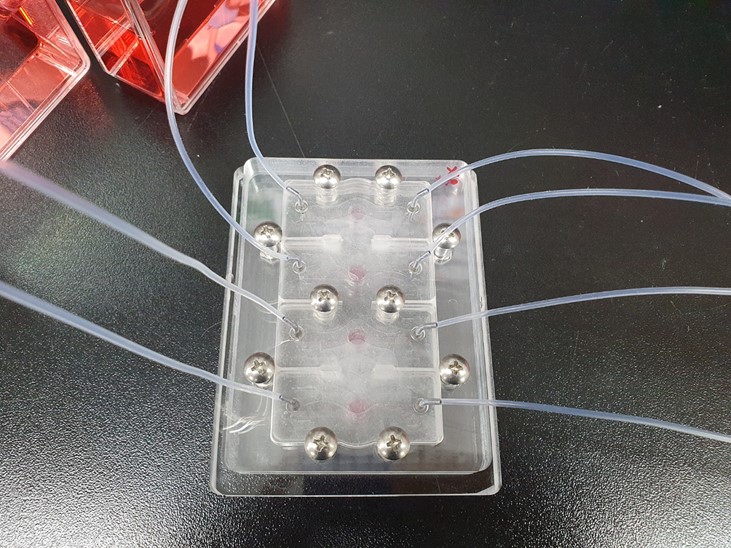
Introduction: We upgraded preexisting bladder cancer-on-a-chip (BCOC) by adding T cells and evaluated the antitumor effect of a combination of intravesical Bacille Calmette-Guérin (BCG) and pembrolizumab. Methods: We fabricated bioprinted BCOC with microfluids, incorporating HT1376, MRC-5, HUVEC, THP-1 and Jurkat cells. We evaluated the effector-to-target cytotoxicity, cytokine, and cell viability in 2D culture, live/dead assay, migration assay, and cytokine assay in BCOC. Additionally, we evaluated the antitumor efficacy of the combination of BCG and pembrolizumab in an orthotopic mouse model. Results: The combination group showed the most effective reduction compared to the control in 2D culture (100.0 ± 0.8 % vs. 36.4 ± 0.8 %, p < 0.001). In BCOC, cancer cell viabilities were decreased at 3 days in the BCG group (70.1 ± 9.8 %, p = 0.013) and combination group (49.3 ± 8.1 %, p < 0.001). The combination group showed the highest immune reaction in the cytokine assay (interferon-?, p = 0.045; interleukin-6, p = 0.037) and migration assay (fold change 1.3 ± 0.1, p < 0.001), whereas in the in vivo model, it showed lower signal intensities from days 10 to 14 compared to that in the control group (p = 0.031 and p = 0.014, respectively). No significant weight changes were observed among the groups. Conclusions: We developed a 3D bioprinted BCOC via use of the monocytic THP-1 cells and Jurkat T cells to assess the efficacy of immunotherapy. The combination of BCG and pembrolizumab showed the best antitumor efficacy in BCOC and animal models. SOURCE OF Funding: This research was supported by the Basic Science Research Program through the National Research Foundation of Korea (NRF) funded by the Ministry of Science, ICT & Future Planning (NRF-2019R1C1C1005170 & NRF-2022R1A2C2008207).