The Arthur Smith Institute for Urology, Northwell Health
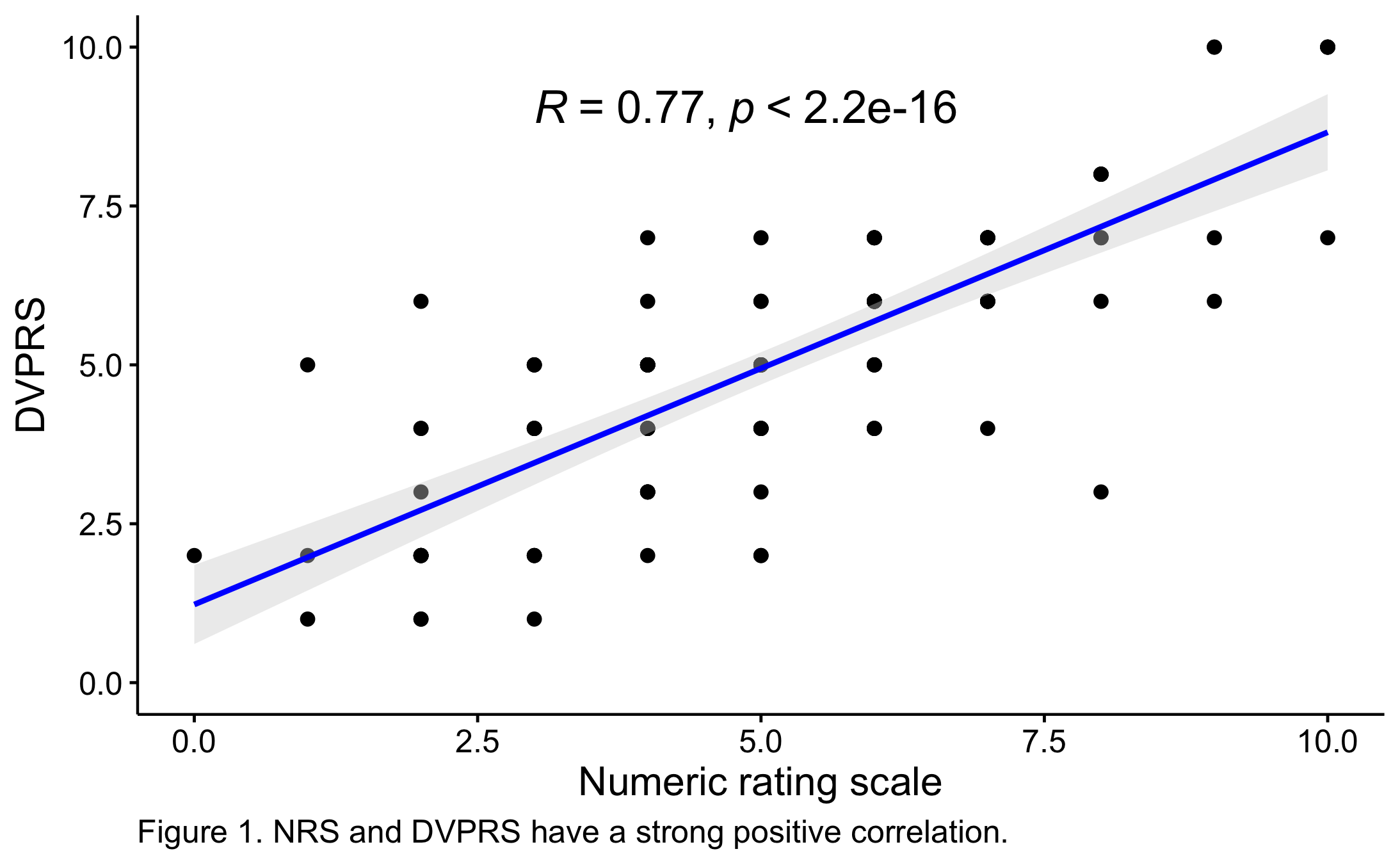
Introduction: Pain scores are essential tools used to assess urologic chronic pelvic pain (UCPP). The Numeric Rating Scale (NRS) rates pain on a 0-10 numeric scale. The Defense and Veterans Pain Rating Scale (DVPRS) is a newly designed and validated pain scale that improves upon the NRS by incorporating faces, color-coded bars, and quality-of-life (QoL) descriptors that correspond to each pain level from 0-10. To our knowledge, the use of DVPRS in patients with UCPP has not been described within the literature. We studied the relationship between the NRS and DVPRS in patients with UCPP. Methods: We retrospectively reviewed the charts of 107 patients with UCPP, including interstitial cystitis, bladder pain syndrome, pelvic floor myalgia, vulvodynia, and chronic prostatitis/chronic pelvic pain syndrome. Patients completed validated survey instruments, including the NRS, DVPRS, and pain catastrophizing score (PCS). The NRS and DVPRS were correlated using the Spearman correlation coefficient. The Wilcoxon signed-rank test was used to analyze the differences between the pain scales. We also analyzed pain levels in relation to sociodemographic data and comorbidities, such as back pain, fibromyalgia, anxiety, and depression. Results: The median patient age was 58. The NRS and DVPRS were positively correlated with each other (R=0.77; p<0.001) (Fig. 1). Both scales were negatively correlated with age, but the association was not significant (NRS: R=–0.10, p=0.30; DVPRS: R=–0.14, p=0.13). The differences in pain scores, defined as NRS minus DVPRS, ranged from -4 to 5, with one potential outlier of 5. However, the Wilcoxon signed-rank test showed no significant differences in pain scores across the two scales (p=0.57). When pain level was categorized into low (0-3), moderate (4-7), and high (8-10), the NRS and DVPRS had no significant associations with pain severity, sex, and comorbidities. Conclusions: Our findings demonstrated that both scales are strongly correlated with no significant differences. Given that the DVPRS relates each pain level to QoL measures, our study suggests that UCPP patients likely take their QoL into account when rating their pain levels on the NRS. SOURCE OF Funding: None