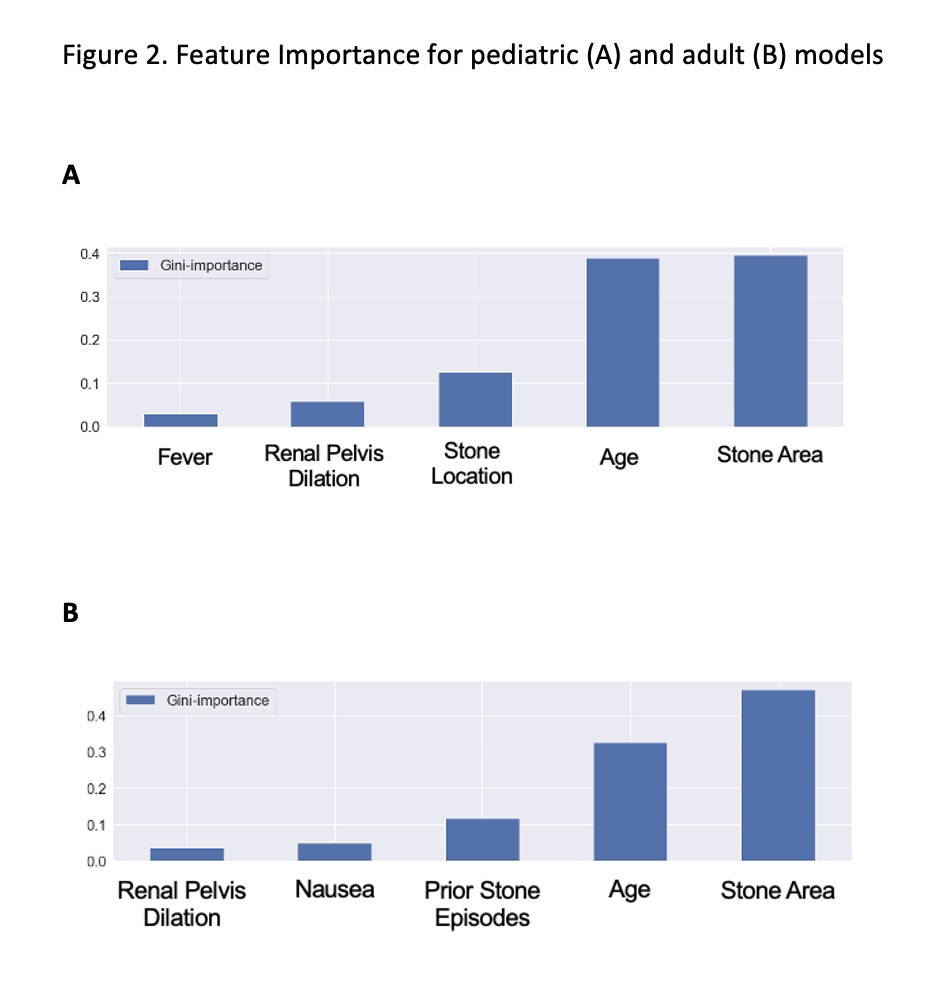
Introduction: Standard treatment options for patients with a ureteral stone are a trial of passage or surgical intervention. Prior studies have tried to identify factors that predict the likelihood of spontaneous passage, such as stone size and location, but this remains difficult. Successful prediction of spontaneous passage can help avoid the risks of unnecessary surgery or shorten the symptomatic period in patients that will ultimately require surgery. Our goal was to create a machine learning model incorporating patient clinical and imaging characteristics to accurately predict the likelihood of ureteral stone passage. Methods: We performed a retrospective cohort study of pediatric and adult patients presenting with ureteral stones on CT scan. Chart review was performed to ascertain patient clinical and imaging characteristics and to determine the primary outcome of spontaneous stone passage. A random forest model was built using these characteristics to predict spontaneous ureteral stone passage. Results: 103 pediatric (median age 14 years, 56% female) and 153 adult (median age 57 years, 35.9% female) patients with confirmed ureteral stones were identified. Spontaneous passage occurred in 54% of pediatric and 44.4% of adult patients. Separate models were created for pediatric and adult patients since different features were important for prediction in each cohort. The pediatric model had an accuracy of 70% (95%CI 67-74%) and the adult model 63% (95%CI 58-66%). Stone area was the most important feature in both models (Figure 2). Conclusions: We created a machine learning model that predicted ureteral stone passage based on clinical and imaging features with 63-70% accuracy. Our long-term aim is to create a deep learning model that incorporates clinical characteristics and automated segmentation of CT imaging to accurately predict stone passage without the need for human abstraction and input. Our hope is that this will allow for better individualized patient care through early identification of those who will have a successfully trial of passage versus those that require surgical intervention. SOURCE OF Funding: NIDDK P20 CHOP/ Penn Center for Machine Learning in Urology (P20DK127488) AUA Care Foundation and SPU Sushil Lacy Research Scholar Award (KMF)