MP17-12: Immune score of tumor-infiltrating CD8+ and FoxP3+ lymphocytes as a novel prognostic biomarker in high-risk localized prostate cancer who underwent radical prostatectomy
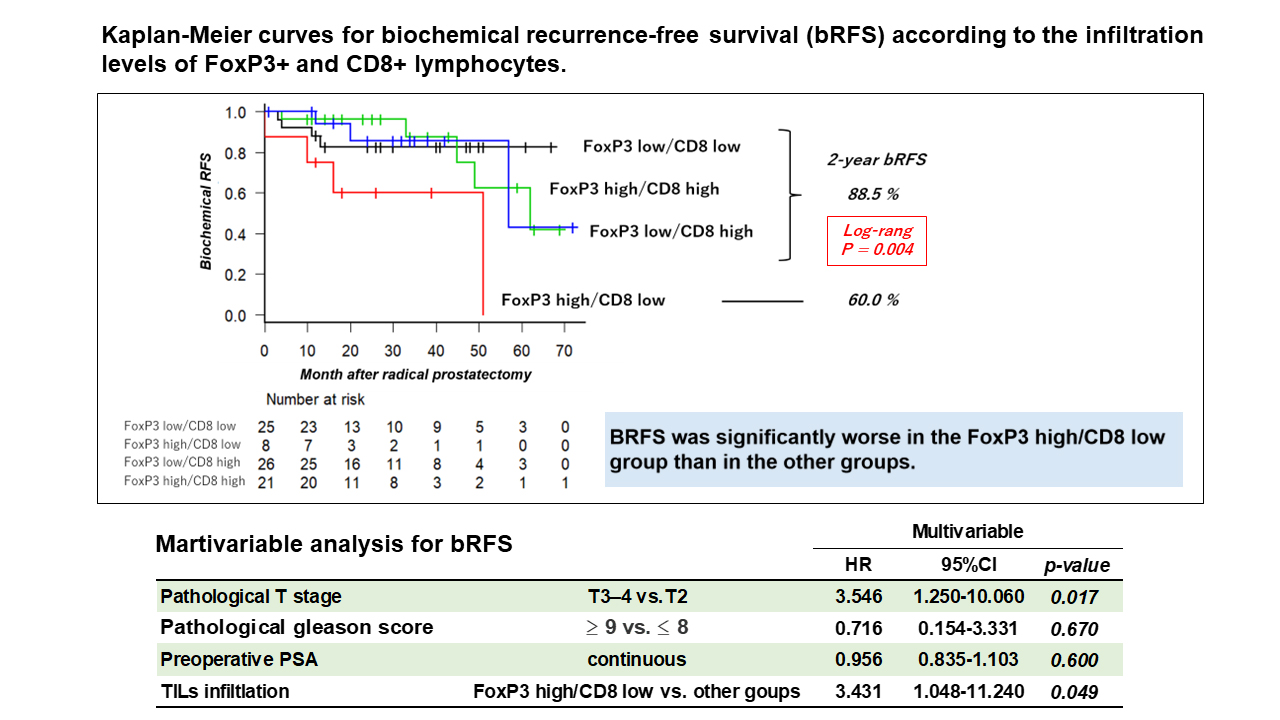
Introduction: For several cancer patients, immunotherapy has resulted in better outcomes, and tumor-infiltrating lymphocytes (TILs) have promising potential to be associated with prognosis of cancer. However, the clinical significance of TILs in high-risk localized prostate cancer (HRLPCa) is largely unknown. Here we investigate the effect of tissue-resident T cells on clinical outcomes in patients with HRLPCa who had a radical prostatectomy (RP). Methods: Tumor microarrays were built using prostatectomy specimens from 240 cores of 80 HRLPCa treated with RP. Each specimen was scored individually using immunohistochemistry for the mean numbers of the CD3+, CD4+, CD8+, and FoxP3+ TILs (IHC). After being classified into high- and low-infiltration groups for each TILs, the association between the immune scores, clinicopathological characteristics, and biochemical recurrence-free survival (bRFS) was statistically evaluated. Results: Patients in the higher infiltrate groups for CD3+, CD4+, CD8+, and FoxP3+ TILs had significantly lower PSA levels than those in the lower infiltrate groups, and the rate of pathological T3–4 disease was significantly higher in the low CD4+ group than in the CD4+ high group (p = 0.015). No significant difference in bRFS was observed between the low and high groups of each TILs. The FoxP3 high+CD8 low group had significantly worse bRFS than the other groups (2-year bRFS: 88.5% vs. 60.0%, p = 0.004) after the groups were divided into four groups, including FoxP3 low +CD8 low, FoxP3 low+CD8 high, FoxP3 high+CD8 low, and FoxP3 high+CD8 high. In contrast, the combination of CD4 and FoxP3 scores was not statistically related to bPFS (p = 0.228). FoxP3 high+CD8 low was found to be an independent predictor of bRFS outcome in the multivariate analysis (hazard ratio: 3.431; 95% CI: 1.048–11.240; p = 0.049); as well as pathological T3–4 diseases (hazard ratio: 3.546; 95% CI: 1.250–10.060; p = 0.017). Conclusions: The combined IHC scores with CD8 and FoxP3 in RP specimens may be a potential biomarker for biochemical recurrence in patients with HRLPCa. SOURCE OF Funding: GlaxoSmithKline plc