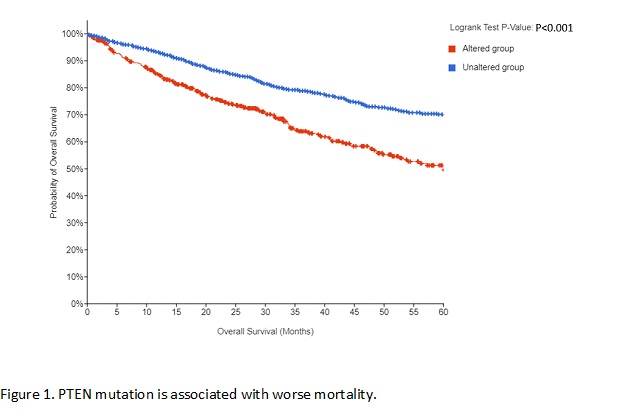
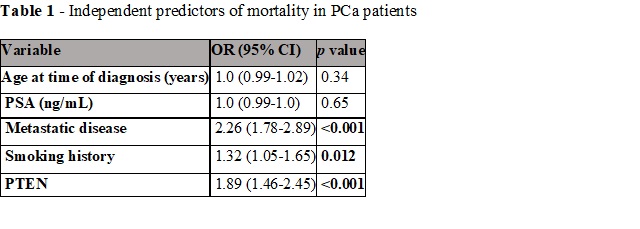
Introduction: Tobacco smoking has been established as a risk factor for a majority of cancers, representing one of the most important modifiable risk factors. However, the association between smoking and prostate cancer (PCa) remains unclear. We compared gene mutations using a next generation sequencing (NGS) database of smokers and non-smokers with PCa. Methods: Data is derived from the American Association for Cancer Research Project Genomics Evidence Neoplasia Information Exchange (GENIE) registry. We included 1832 men with PCa in our study cohort, categorized as either smokers or non/never smokers. We compared the frequency of mutations (point mutations, copy number variations and structural variants) of 47 genes between the 2 groups. We also studied the association of the gene mutations with overall survival. Univariate and multivariate logistic regression analyses were conducted to identify factors associated with mortality. Results: Within the study cohort, 1007 (55%) patients were non-smokers and the remaining 825 (45%) were smokers. Patients with a smoking history had a higher percentage of somatic mutations in PREX2 (p = 0.018), PTEN (p = 0.02), AGO2 (p = 0.03), and KMT2C (p = 0.04) compared to non-smokers. In contrast, non-smokers had a higher percentage of somatic mutations in APC (p = 0.02) and KMT2A (p = 0.04) compared to smokers. The mortality rate was significantly higher among the smoker population (p = 0.006). The presence of metastatic disease at the time of diagnosis (OR 2.26, p < 0.001), smoking history (OR 1.32, p = 0.02), and PTEN somatic gene mutation (OR 1.89, p < 0.001) were independent predictors of mortality among patients diagnosed with PCa (Table 1). Conclusions: PCa patients with a tobacco smoking history had significantly higher somatic mutations of PREX2, KMT2C, AGO2, and PTEN genes. Moreover, PTEN somatic gene mutation is linked to mortality among patients with PCa (Figure 1). SOURCE OF Funding: none