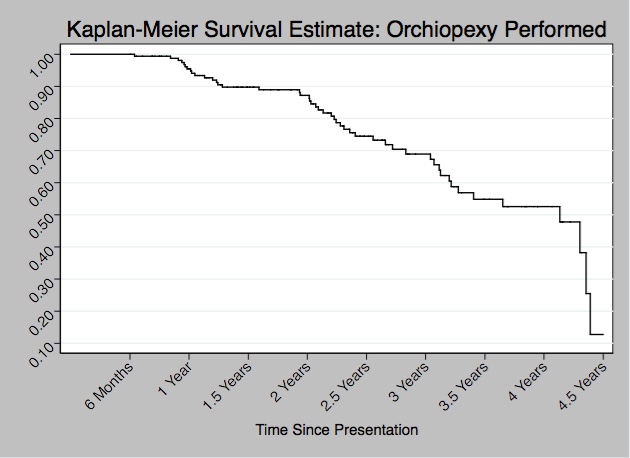
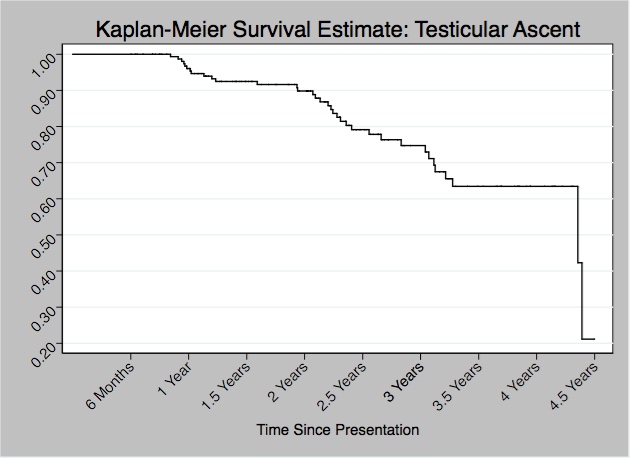
Introduction: This study aims to evaluate the incidence of 1) testicular ascent and 2) orchiopexy for any reason among boys with a history of retractile testicle(s). We hypothesized that incidence of both ascent and orchiopexy is higher than previously published rates. Methods: A single-institution retrospective review of boys < 18 years diagnosed with a retractile testis between 1/18-8/20 and followed until 10/22 was performed. Boys were identified by ICD9/10 codes for retractile testis and a manual chart review was performed. Exclusion criteria included absent/unreliable testicular exam, planned orchiopexy at diagnosis, and followup < 6 months. Kaplan-Meier survival curves were generated for time to ascent and time to any orchiopexy. Cox regression was performed. Results: 642 boys with a history of retractile testes were identified. 145 were excluded for unclear physical exam findings or planned intervention at diagnosis; 334 were excluded for followup < 6 months. A total of 163 boys identified at median 4.3 years [SD 0.7-14] were followed with serial exams for >6 months (median 809 days [SD 511-1121]). 35 (21.5%) developed ascent at a median 792 days [SD 413-1034] of followup (Figure 1). Cox regression demonstrated no association between the likelihood of ascent and race (p=0.41), ethnicity (p=0.99), laterality (p=0.11), or age at diagnosis (p=0.12). There was an association between the likelihood of ascent and having a PCP in our system routinely examine the testes (n=51, HR 7.3 [1.69-31.15]) and with lower BMI (HR 0.72 [0.60-0.87]). A total of 29.4% of boys ultimately underwent orchiopexy for any reason: 6 (3.7%) for torsion of the retractile testis, 5 (3.1%) for difficult exam making diagnosis unclear, and 2 (1.2%) for pain with retraction (Figure 2). Conclusions: 21.5% of 163 boys with retractile testis followed for > 6 months developed ascent at a median 792 days; 29.4% underwent orchiopexy for any reason. Future directions include expanding this study to include more recent patient data, given the time period to ascent, and accruing additional data years. SOURCE OF Funding: None