MP18-13: Is indocyanine green superior to surgeon’s subjective assessment when creating a catheterizable channel? Development of a standardized protocol
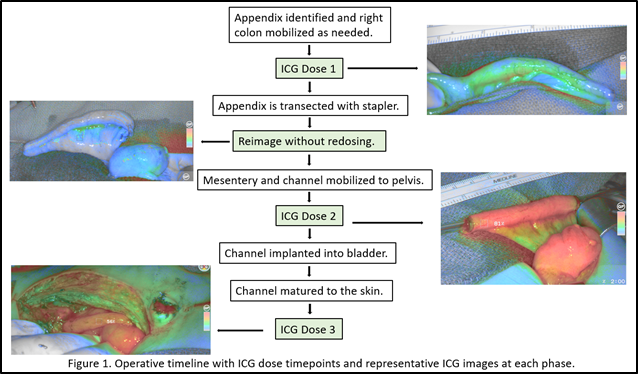
Introduction: While we know blood supply to catheterizable channels is important to their long term success, there is currently no objective means to assess perfusion. Indocyanine green has a well established use in the evaluation of bowel perfusion, however, use has not been reported in catheterizable channels. Our aims were to develop a standardized protocol for using ICG in the creation of catheterizable channels and establish perfusion patterns of the channels. Methods: A standardized protocol for the use of ICG in catheterizable channel creation was developed in an adaptive process in this single institution pilot study. Stryker’s SPY PHI system and SPY-QP quantification system were used. SPY-QP allowed for quantification of ICG uptake in the channel relative to healthy bowel. The standardized protocol is described in figure 1. Results: ICG was used in the creation of 3 new appendicovesicostomies and 1 channel revision. Overall, perfusion to the channel decreased with increasing mobilization, but degree of decrease varied between patients. The median ICG uptake went from 85.5% immediately after stapling the appendix to 63.5% when examining the subfascial channel after maturing and 27% at the stoma. In the one revision, ICG clearly delineated an area of poor perfusion in the distal channel after complete mobilization of the channel off the skin and fascial attachments. Conclusions: The standardized protocol for use in catheterizable channels was successfully implemented. In the channel revision, ICG clearly delineated the area of distal hypoperfusion after channel takedown. ICG can provide surgeons with an objective assessment of channel perfusion rather than relying on subjective assessment alone. SOURCE OF Funding: None