PD09-09: Survival Benefits of Adjuvant Chemotherapy for Positive Soft Tissue Surgical Margins Following Radical Cystectomy in Bladder Cancer with Extravesical Extension
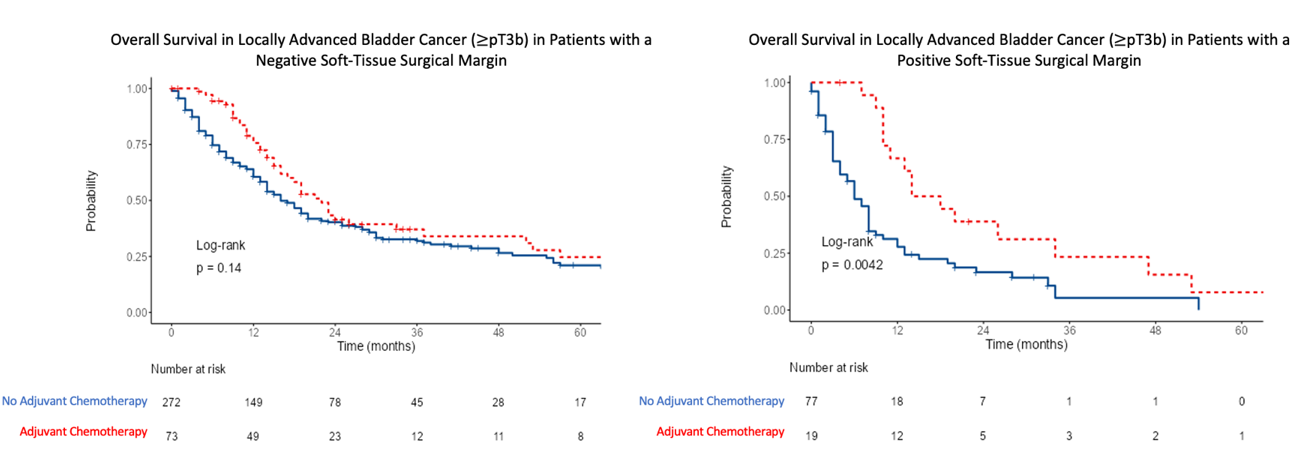
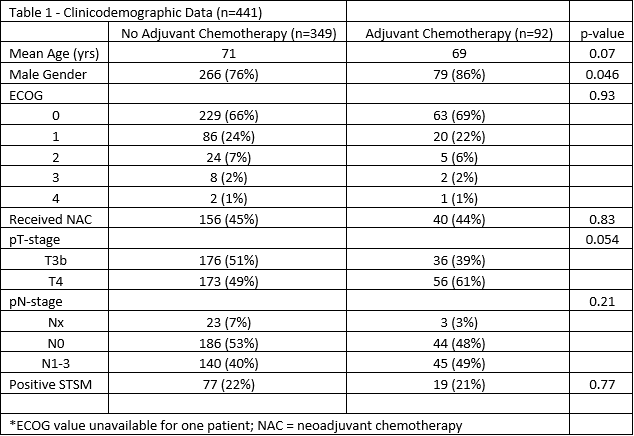
Introduction: Locally advanced muscle invasive bladder cancer is an aggressive disease entity that requires multimodal therapy. However, the benefits of adjuvant chemotherapy (AC) in patients with a positive soft-tissue surgical margin (STSM) are relatively unknown. We sought to define survival benefits in this cohort in our institutional bladder cancer database. Methods: We performed a retrospective review of all patients undergoing radical cystectomy for urothelial carcinoma of the bladder at Moffitt Cancer Center from 2004-2020 with gross extravesical (=pT3b) disease irrespective of neoadjuvant chemotherapy (NAC) use or pathologic lymph node metastases. Overall survival estimates were obtained using the Kaplan-Meier method with log-rank test and the Cox-proportional hazards model was used to identify predictors of overall survival. AC was defined by any chemotherapy use within 90 days of cystectomy, regardless of STSM status. Results: 441 patients with pT3b disease or worse and adjuvant chemotherapy data were identified. Baseline clinicodemographic information are listed in Table 1. Positive STSM (HR 1.90, 1.42-2.53, 95% CI, p<0.001) and AC use (HR 0.63, 0.47-0.84, 95% CI, p=0.002) were significantly associated with poorer overall survival when adjusted for pathologic T-stage, N-stage, performance status and NAC use. On subgroup analysis, as shown in Figure 1, the use of AC in patients with a positive STSM improved median OS from 6 months [4 - 8, 95% CI] to 16 months [11 - 53, 95% CI] (p < 0.01). In patients with a negative soft-tissue surgical margin, the median survival with AC was 22 months [17 - 37, 95% CI] compared to 16 months [14 - 20, 95% CI] without (p = 0.14). ECOG performance status, NAC use, rates of pathologic nodal involvement, and LVI did not differ by AC use in the entire cohort or based on STSM status. Conclusions: Adjuvant chemotherapy may particularly benefit patients with positive STSM following radical cystectomy for gross extravesical disease. SOURCE OF Funding: None