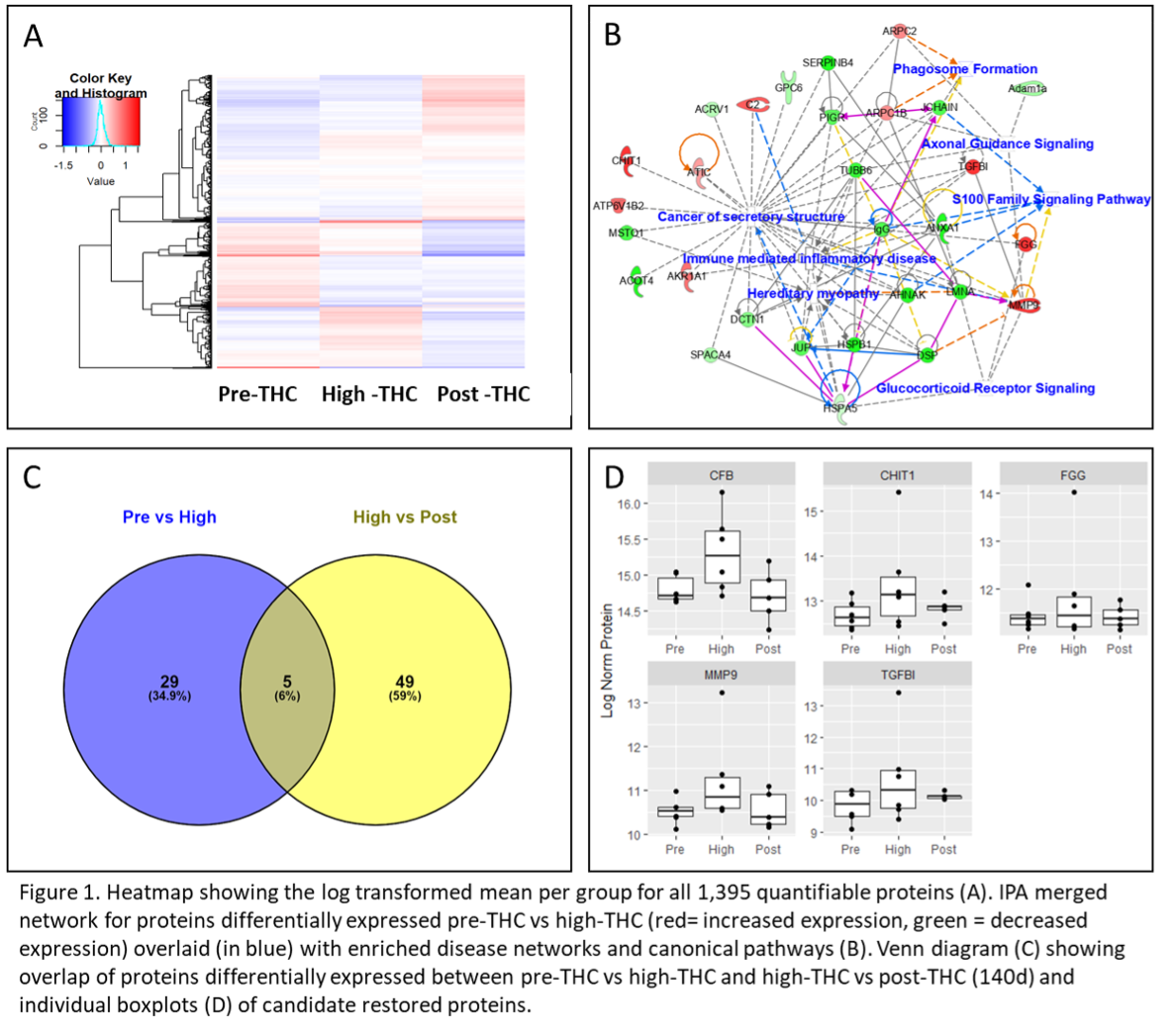
Introduction: Cannabis use has been associated with male infertility, but the etiology is not well understood. Seminal fluid is comprised of multiple factors (e.g. proteins), that influence fertility. Our objective was to determine the impact of chronic delta-9-tetrahydrocannabinol (THC) use on the seminal fluid proteome in a rhesus macaque (RM) model. Methods: 6 adult RMs were given a daily THC edible over 280 days (~4 spermatogenesis cycles) with serial non-sedated semen collection. Differential expression of proteins in the seminal fluid at baseline (pre-THC), high-THC dose (2.5mg/7kg/day), and post-THC discontinuation for 140 days (~2 spermatogenesis cycles) was evaluated. Proteomic analysis was performed by liquid chromatography tandem mass spectrometry followed by statistical analysis to identify differentially expressed proteins. Results: Proteomic analysis resulted in 1,395 quantifiable proteins (Fig1A). The average percent identity was 88.6% (SD=14.9%). All RM proteins were matched to human proteins with 99.4% of the RM proteins (1,386) exceeding an identity cutoff of 44.3% (average minus 3 SDs). 7 proteins reached FDR significance in any contrast, thus we focused downstream analyses on nominally significant candidate proteins. Ingenuity Pathway Analysis (Fig1B) revealed that high-THC exposure was associated with dysregulation of pathways related to “Remodeling of Epithelial Adherens Junctions”, “Axonal Guidance Signaling”, and “Glucocorticoid Receptor Signaling”. THC discontinuation for 140 days was associated with decreased “LXR/RXR Activation”, “Acute Phase Response Signaling”, and “Production of Nitric Oxide and ROS in Macrophages”. 5 proteins dysregulated with THC and significantly restored to baseline included products of CHIT1, FGG, MMP9, TGFBI, and CFB genes (Fig1D). CHIT1 has been associated with oligozoospermia and MMP9 protein with sperm motility. Conclusions: This study demonstrated the translational strength of the RM model to study male reproductive health; there was significant seminal fluid proteome homology between humans and RMs. THC-exposed RMs are likely to exhibit proteins in their seminal ejaculate that are involved in regulatory processes that could potentially contribute to male infertility. SOURCE OF Funding: OHSU Faculty SEED Award and ASRM Pilot and Exploratory Grant