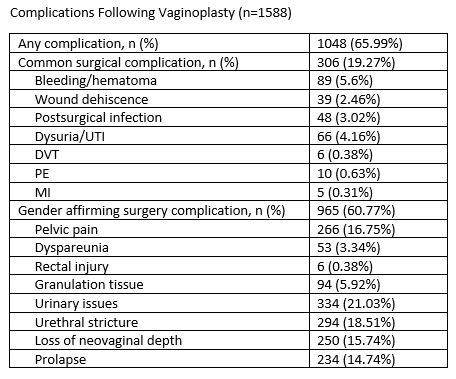
Introduction: Transfeminine genital reconstructive surgery is an important part of gender affirmation for many transgender women. Currently, various vaginoplasty techniques are performed by surgeons across the United States. While surgical outcomes have been previously reported by individual surgeons and groups, complications using an insurance claims database have yet to be reported. Our objective is to present complication rates among surgeons using a large claims database. Methods: A retrospective review was conducted of all transgender women who underwent vaginoplasty using IBM MarketScan claims database between 2011-2020. Baseline patient characteristics such as age, obesity, smoking status, Charlson Comorbidity Index (CCI) and the region surgery was performed were obtained. Patients were followed after surgery to identify complications. Common surgical complications, including bleeding/hematoma, wound dehiscence, postsurgical infection, DVT, PE, and MI, and complications specific to gender affirming surgery, such as rectal injury, urinary issues, urethral stricture, loss of neovaginal depth, and prolapse, were investigated using ICD-9/ICD-10 and CPT codes. Hazard ratios (HRs) were calculated to determine how baseline factors influenced complications. Results: A total of 1588 privately insured patients who underwent vaginoplasty for gender affirmation with 414 different surgeons were identified. Mean age was 34 years (22-53 years), 16% were obese and 8% were smokers. The majority (70%) of patients had a CCI of 0. Overall, at a mean follow-up of 14 months (5-28 months), 66% of patients had a complication. A common surgical complication occurred in 19% and a gender affirming surgery complication occurred in 61%. Among those with a gender affirming surgery complication, <1% had a rectal injury, 21% had urinary issues, 19% had a urethral stricture, 16% had loss of neovaginal depth and 15% had prolapse (Table). Smoking was the only factor that was found to have a statistically significant HR for both common and gender affirming complications (1.48 and 1.26, respectively; P<0.05). Conclusions: Post-vaginoplasty, the majority of patients have at least one complication based on claims data. All patients should be counseled on smoking cessation prior to surgery to potentially decrease the rate of complications. SOURCE OF Funding: None