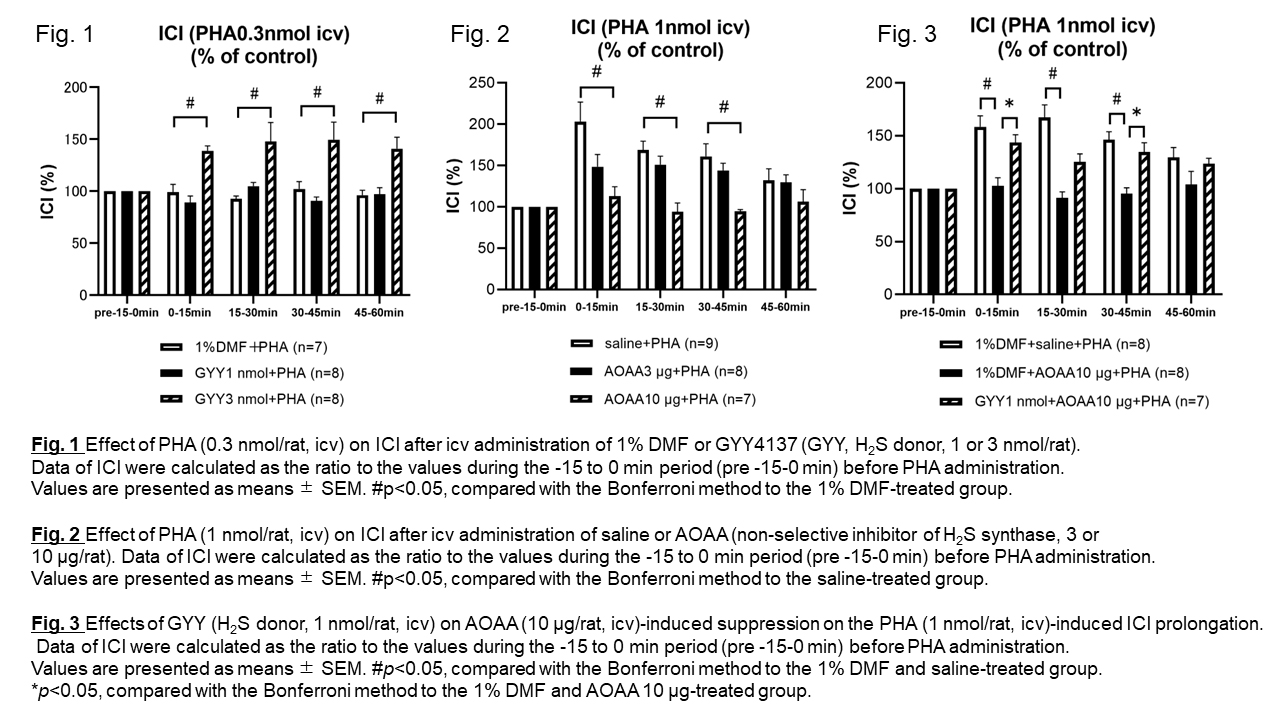
Introduction: We previously reported that brain a7 nicotinic acetylcholine receptors (a7 nAChRs) and brain hydrogen sulfide (H2S) suppressed the rat micturition reflex via brain GABA receptors. However, it is unclear how the brain a7 nAChRs and brain H2S are related to each other in regulation of the micturition reflex. In this study, we examined whether brain H2S is involved in the suppression of micturition induced by stimulation of brain a7 nAChR. Methods: Urethane anesthetized (0.8 g/kg, ip) male Wistar rats (350-420 g) were used. A catheter was inserted into the bladder to perform continuous cystometry (12 ml/h saline infusion). We examined effects of intracerebroventricularly (icv) pretreated GYY4137 (GYY, H2S donor, 1 or 3 nmol/rat) or AOAA (non-selective inhibitor of H2S synthesis, 3 or 10 µg/rat) on PHA568487 (PHA, a7 nAChR agonist, 0.3 or 1 nmol/rat, icv)-induced intercontraction intervals (ICI) prolongation. Continuous cystometry and evaluation of ICI and maximal voiding pressure (MVP) was started 120 min after the surgery and the first icv administration was performed 60 min after starting cystometry. Results: PHA at a lower dose (0.3 nmol/rat) showed no significant effect on ICI, while under pretreatment with GYY, PHA (0.3 nmol/rat) significantly prolonged ICI even at a lower dose (Fig. 1). PHA at a higher dose (1 nmol/rat) induced ICI prolongation and the PHA-induced prolongation was significantly suppressed by AOAA (Fig. 2). The AOAA-induced suppression of the PHA-induced ICI prolongation was cancelled by supplementation of brain H2S via GYY (Fig. 3). PHA at each dose showed no effect on MVP (data not shown). Conclusions: Brain a7 nAChRs suppressed the rat micturition reflex via brain H2S, therefore, brain a7 nAChRs and H2S might be new therapeutic targets for neurogenic bladder overactivity. SOURCE OF Funding: Smoking Research Foundation in Japan, KAKENHI (#20K07827), The Kochi Medical School Hospital President’s Discretionary Grant