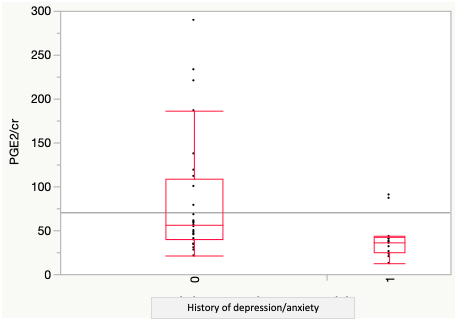
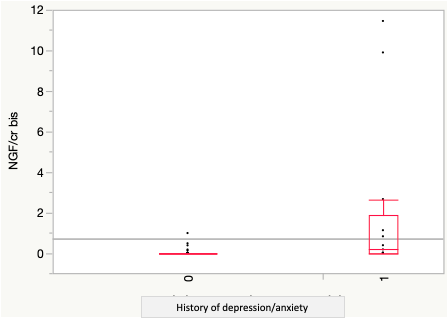
Introduction: The objective of this study was to evaluate the association between the level of 5 urinary markers (NGF, BDNF, TIMP-2, TGF-B1, and PGE2) and the characteristics of patients with overactive bladder underpinned by detrusor overactivity (OAB-DO) and their possible association with response to treatment Methods: A single-center prospective study was conducted between March 2015 and June 2017 including all consecutive patients with OAB referred for urodynamics in whom filling cystometry evidenced detrusor overactivity. At the end of the inclusion period, the urine samples were unfrozen to assess the level of NGF, BDNF, TIMP-2, PGE2, TGF-B1 using dedicated ELISA kits. The association between urinary marker levels and patient characteristics was investigated. Results: Forty-three patients were included all with non-neurogenic OAB underpinned by detrusor overactivity on urodynamics. Patients with affective disorders (anxiety, depression) had significantly higher levels of NGF/Cr (2.04 vs. 0.07 pg/mg creatinine; p=0.006) and significantly lower levels of PGE2/Cr compared to other patients (40.6 vs. 83.4 pg/mg creatinine; p=0.008). There were no other statistically significant associations between urinary markers and patient characteristics. There was also no association between urinary marker levels and response to anticholinergics. In contrast, patients who responded to posterior tibial nerve stimulation (PTNS) had significantly lower BDNF/Cr levels (3.5 vs. 7.6 pg/mg creatinine; p=0.03). Conclusions: In this study there was a molecular signature in the subgroup of patients with affective disorders with significantly higher NGF and significantly lower PGE2 levels compared to other OAB-DO patients. These results reinforce the hypothesis of an OAB phenotype associated with anxiety/depression with a specific pathophysiology. BDNF/Cr may be predictive of response to PTNS SOURCE OF Funding: none