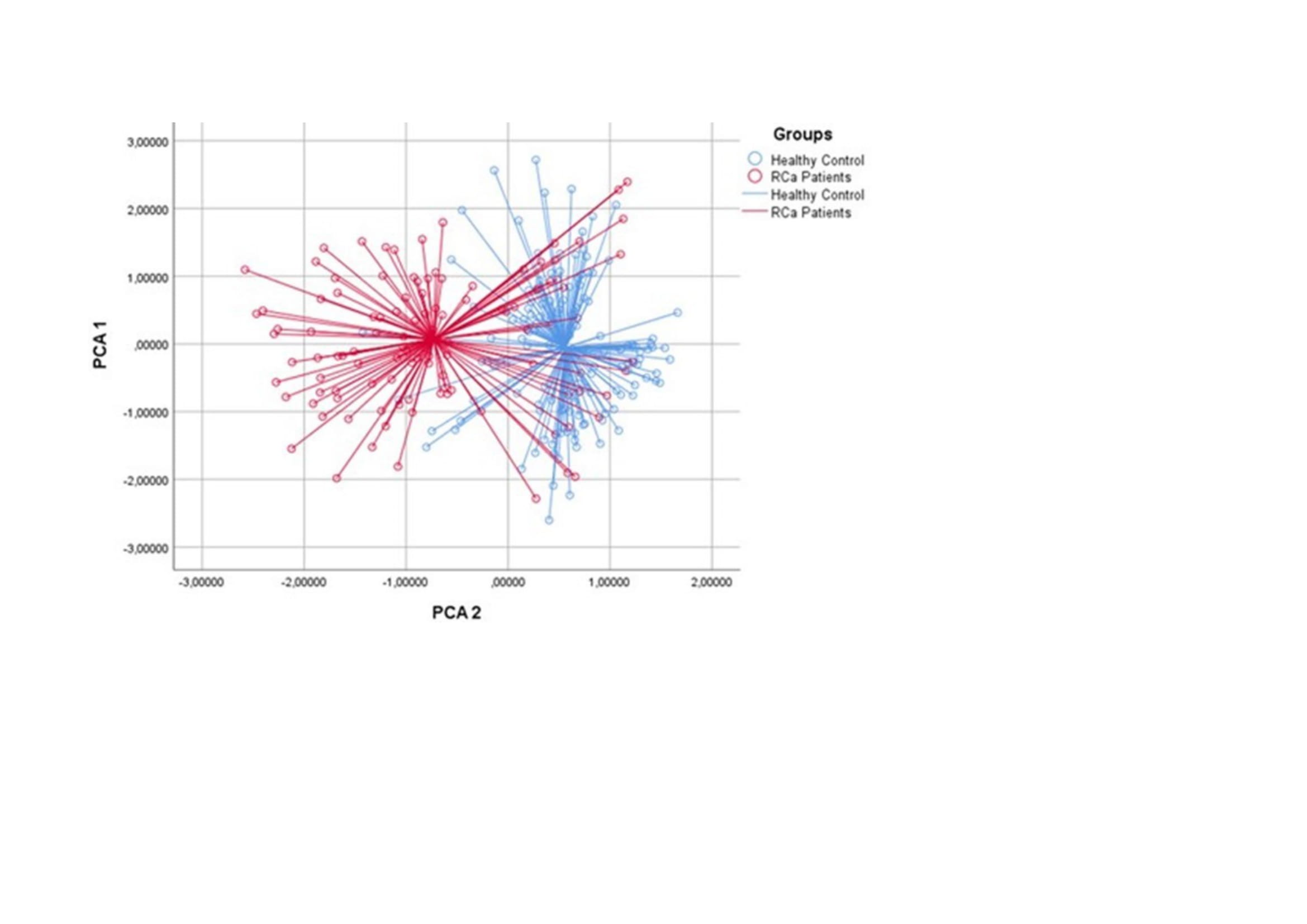
Introduction: Although challenging and highly expensive for health systems worldwide, no useful markers are available in clinical practice that aim to anticipate renal cancer diagnosis in the early stages in the context of wide population screening. Urine analysis by an electronic nose provides volatile organic compounds (VOCs) easily usable in the diagnosis of urological diseases. Some previous works suggested that dogs trained to smell urine could recognize lung, bladder, or breast cancer with various success rates, but no strong results have been reported in renal cancer (RCC) setting. In this study, we investigated the diagnostic potential of urinary VOCs profiling by enose in discriminating renal patients from healthy controls Methods: This prospective pilot study includes 252 individuals subdivided in two groups: 110 RCC patients, and 142 healthy controls. For each case, urine samples were collected, stabilized at 37°C, and twice analyzed using a commercially available electronic nose (Cyranose C320-32 sensors). Statistical analysis of the sensor responses was performed off-line using principal component (PCA) analyses and discriminant analysis (CDA). The best discriminating principal component groups were identified with univariable ANOVA analysis. We used the “leave-one-out method” to calculate the Cross Validated Accuracy (CVA), an estimate of accuracy of a predictive model in clinical practice. The discrimination accuracy of the built model was evaluated by ROC curves Results: Based on PCA analysis, 79/110 and 127/142 cases were correctly identified in RCC and healthy control cohorts, respectively (sensitivity 71.8%, specificity 89.4%; positive predictive value 84.4%, negative predictive value 80.3%). Results obtained with CDA demonstrated a correct classification in 81.7% of cases (p <0.001). At ROC analysis, the discrimination accuracy of the model (area under the curve (AUC) was 0.85. Repeated analysis of a second measurement of urine samples provided comparable findings Conclusions: This study provides a first evaluation of urinary volatilome in RCC. Urine VOCs profiling by e-nose seems a promising, non-invasive diagnostic tool with high accuracy in discriminating patients from controls. Ease of use, low costs and non-invasive nature makes this test a potential molecular biomarker in early RCC diagnostic settings SOURCE OF Funding: Italian Ricerca Corrente 2022