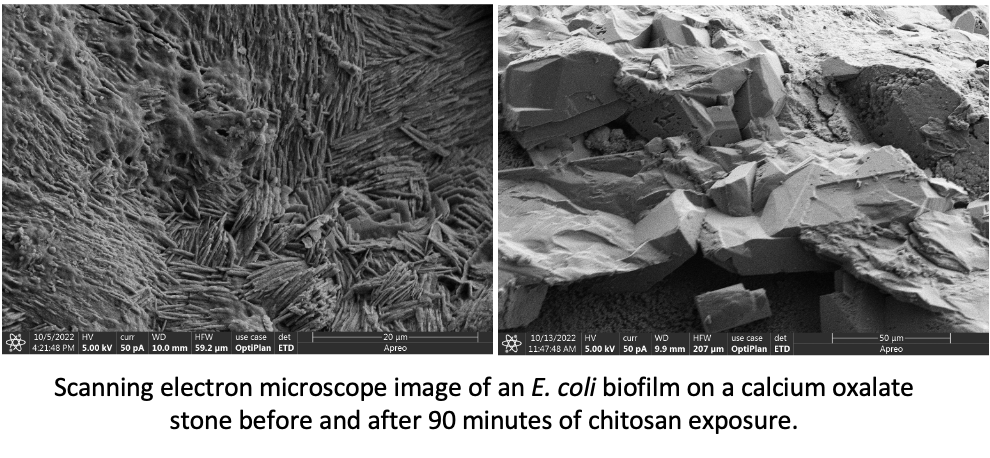
Introduction: Up to 40% of kidney stones are colonized by bacterial biofilms. Stone fragmentation by ureteroscopic (URS) laser lithotripsy or percutaneous nephrolithotomy (PCNL) can disperse bacteria thereby increasing the risk of post-surgical infection, urosepsis, and stone recurrence. We hypothesized that the addition of chitosan, an established biopolymer with reported antimicrobial properties, may eradicate uropathogens and bacterial biofilms associated with kidney stones. Methods: With IRB approval and patient consent, preoperative urine and intraoperative stone fragments were collected from patients undergoing URS and PCNL. In vitro biofilms and planktonic bacteria were assessed and quantitated by scanning electron microscopy. Colony forming units on agar plate culture and optical density were used to measure the bactericidal effects of chitosan on common uropathogens found in kidney stones. Stones were divided into a control group treated with saline for 90 minutes and an experimental group with a chitosan solution in saline. All samples were analyzed to determine bacterial presence, species, and biofilm integrity. Results: In vitro culture demonstrated that as low as 0.0001% (w/v) chitosan inhibited growth in the planktonic form of the most common uropathogens found in stone formers (i.e. E. coli, Proteus mirabilis, Klebsiella pneumoniae and Staphylococcus aureus). Further, up to 90% of biofilms grown in vitro on a synthetic support or calcium oxalate stone were disrupted with 0.0005% (w/v) chitosan. Ex vivo experiments measuring the effect of chitosan on patient derived urine and stone fragments are underway to assess differences in urine and stone culture and if chitosan can effectively disrupt complex in vivo formed biofilms. Conclusions: Chitosan inhibits growth of both gram-negative and gram-positive uropathogens and disrupts their biofilms in vitro on kidney stones. Ex vivo experiments with patient derived stones will confirm the antimicrobial effects of chitosan on complex biofilms. Chitosan may be a promising additive to the saline irrigation to reduce post-surgical infections in kidney stone surgery. SOURCE OF Funding: NIH R21 DK131776