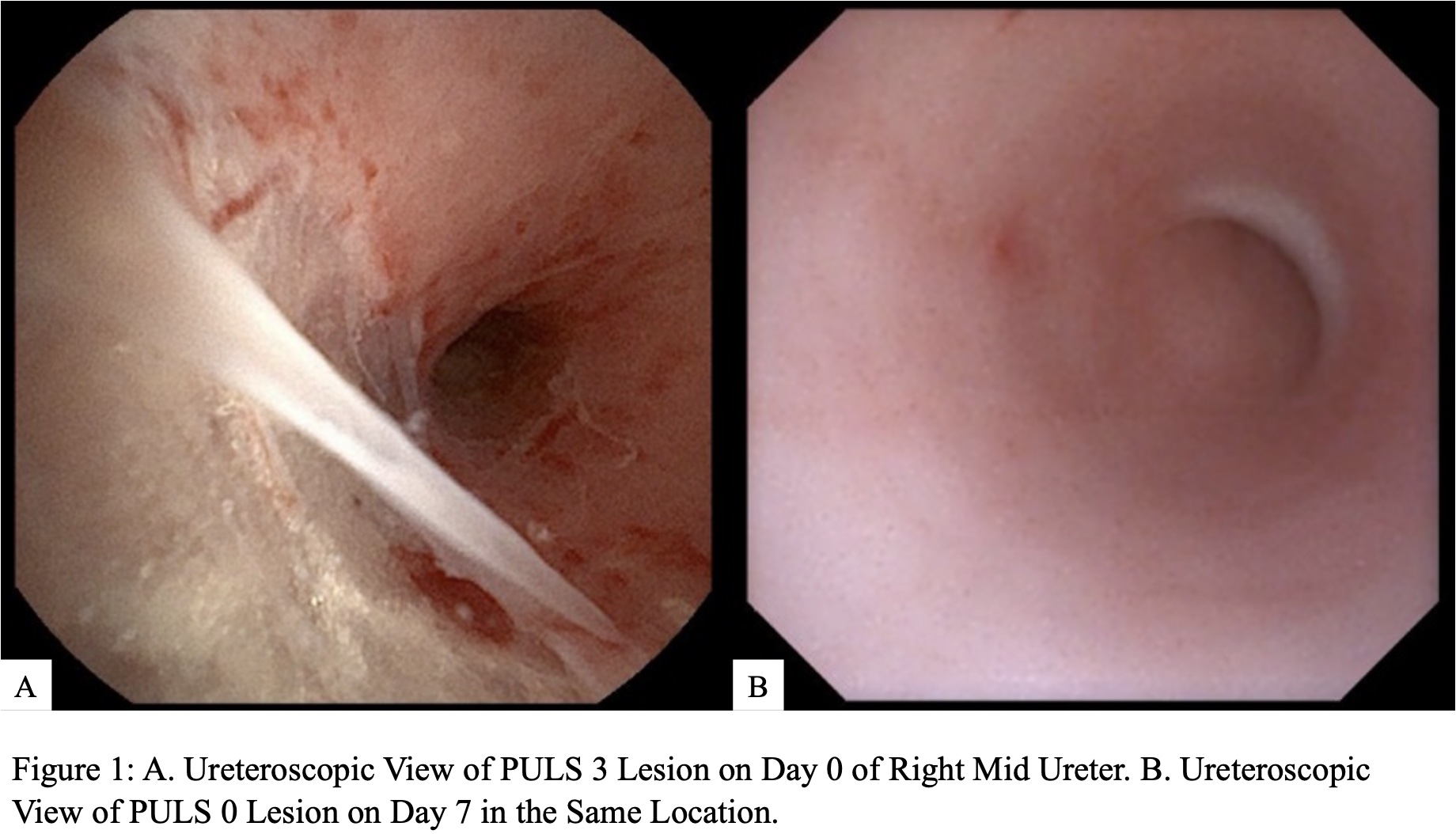
Introduction: Ureteroscopy (URS) accompanied by passage of a ureteral access sheath (UAS) is a common procedure for the treatment of urolithiasis; however, the ureter may sustain an injury during UAS placement. The post-ureteroscopic lesion scale (PULS) is a validated scoring system for endoscopic detection of ureteral injury. PULS Grade 3 (perforation with less than 50% partial transection) and Grade 4 (greater than 50% partial transection) are considered severe injuries generally requiring prolonged stent placement. The natural history of these lesions if left unstented, is unknown. Methods: Female Yorkshire pigs underwent ureteral sizing with Cook® urethral dilators (10-24 Fr) using a validated force sensor with forces limited to < 6 N; passage of the urethral dilators resulted in PULS Grade = 3 in 13 ureters. These animals were excluded from the original study but were survived for another week without stent placement. On the seventh day, URS was performed to assess ureteral healing and PULS grade. Exact fisher test and Two-Tailed T-test were used to evaluate differences in PULS grade, location (proximal, mid, or distal) and number of dilator passages. Results: Among thirteen PULS lesion Grades = 3 (nine Grade-3 and four Grade-4) in 10 pigs, URS one week later revealed healing in ten ureters (77%) (nine Grade-0 and one Grade-2) (Figure 1); however, three ureteral strictures were noted, all associated with prior Grade-3 lesions (23%). In addition, there was no difference in the location of primary lesions becoming strictures (50% in proximal, 0% in medial and 33% in distal, p = 0.2133). Ureters without stricture formation had a higher mean number of dilator passages compared to those that did not stricture, (5.2 vs 3.0, p = 0.0374). Conclusions: Despite PULS 3 or 4 lesions, in the absence of ureteral stenting, the urothelium in 75% of ureters healed completely within a week. SOURCE OF Funding: none