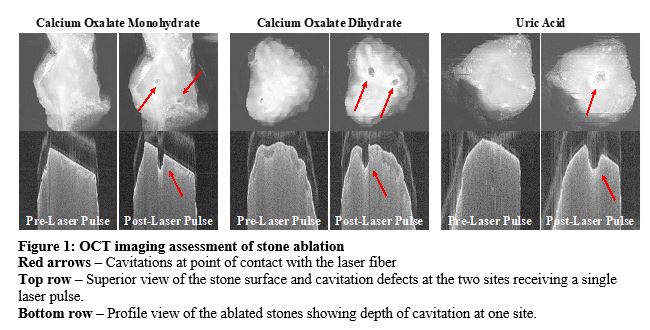
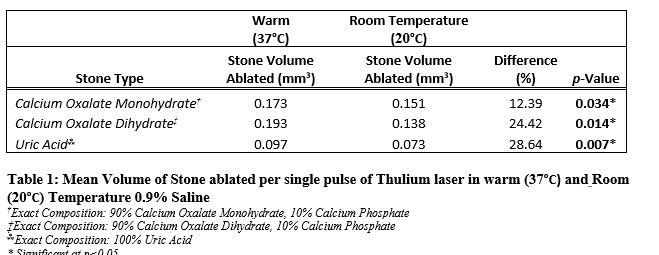
Introduction: The absorption coefficient measures the energy lost to the medium through which a laser beam passes. Prior mid-infrared laser studies have shown that as the temperature of the medium increases, there is less loss of energy into the medium. Accordingly, we evaluated the impact of irrigation temperature on the amount of stone ablation when using the superpulse Thulium fiber laser (sTFL). Methods: Optical coherence tomography (OCT), a non-invasive, high-resolution imaging technique, was used to generate a detailed surface image during single pulse sTFL lithotripsy (0.5J, 1.0 Hz, 1.25ms) of 12 samples of each of the following stone compositions: calcium oxalate monohydrate (COM), calcium oxalate dihydrate (COD), and uric acid (UA). Stones were immersed in either room temperature (20°C) or body temperature (37°C) 0.9% saline. With the tip of a 200 µm laser fiber in contact with the stone, a single pulse was applied at two separate sites on each stone. OCT determined the volume of stone removed per each laser pulse. Data were evaluated using an unpaired t-test (Figure 1) (Table 1). Results: Regardless of stone composition, the mean volume of stone ablated during sTFL at 37°C was significantly greater than at room temperature. The single pulse of the sTFL ablated 12.4%, 24.4% and 28.6% more stone at 37°C irrigation for COM stones (p=0.034), COD stones (p=0.014) and UA stones (p=0.007), respectively (Table 1). Conclusions: sTFL efficiency in ablating COM, COD, and UA stones is enhanced when using irrigation warmed to 37°C. SOURCE OF Funding: None.