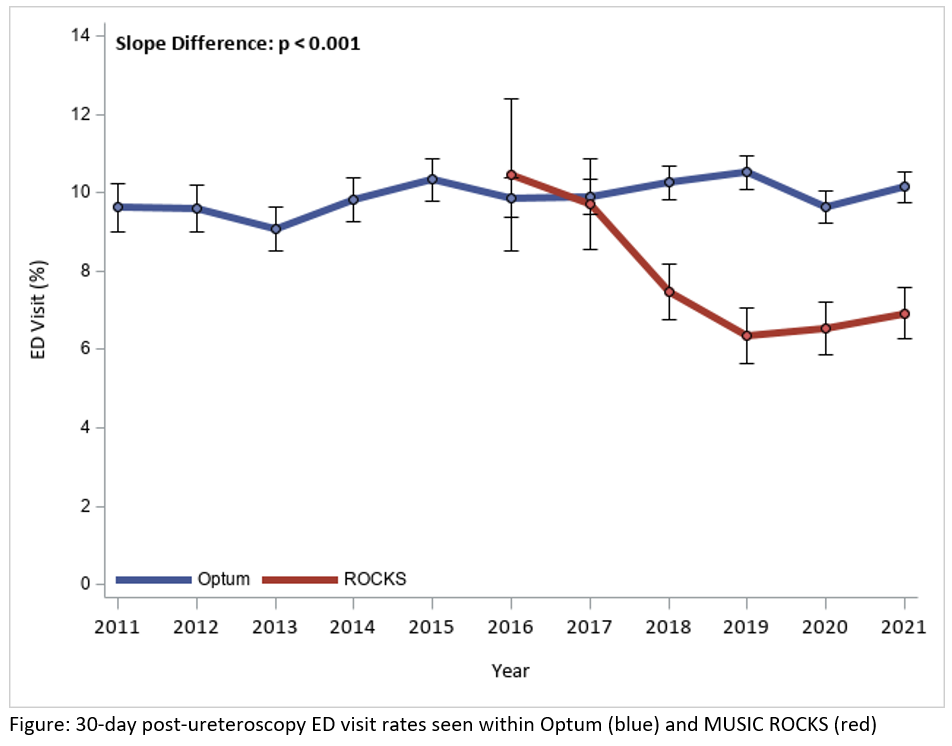
Introduction: The Michigan Urological Surgery Improvement Collaborative Reducing Operative Complications from Kidney Stones (ROCKS) was created to optimize outcomes after ureteroscopy (URS). Through outcomes data collection, distribution of performance reports, patient educational efforts, and standardization of an opioid-free postoperative pain regimen, emergency department (ED) visits in Michigan have declined. It is unclear, whether this trend is unique to Michigan and thus a reflection of these quality efforts or is similar to national data. We thus sought to understand ED visit rates in Michigan compared to a large national dataset. Methods: We used data from two sources for this study to understand 30-day ED visits after URS. In Michigan, the ROCKS database, a prospectively maintained registry including more than 90% of participating urologic practices in the state was utilized, capturing patients from 2016-2021. To serve as comparison, we used Optum claims data from 2011 to 2021 (excluding Michigan), which includes commercially insured adults and dependents. We identified patients who underwent URS defined by CPT codes and calculated the proportion who had an ED visit within 30 days of URS. Cohort age and gender were compared with rank and chi-square tests, respectively. ED rates were modeled (logistic) adjusting for age and gender to compare cohorts over time. Results: Overall, we identified 24,163 patients in ROCKS who underwent URS and 162,642 patients in Optum. Significant differences were seen with regards to gender (51% vs 44% female, p<0.01) and median age (58 vs 62 years, p<0.01) between ROCKS and Optum cohorts. The mean ED rate in ROCKS was 7.9% (range 6.3 to 10.5%) with a significant decline over time (p < 0.01, Figure). The ED rate in Optum was 9.9% (range 9.1 to 10.5%) with an increase over time (p < 0.01). Comparing ED visits between the two cohorts after adjusting for observed demographic differences, the ROCKS ED visit rate declined significantly relative to national Optum rates (p < 0.01). Conclusions: ED visit rates in Michigan have declined significantly after URS since establishment of the ROCKS initiative. This decline outpaces national ED rates, which have gradually increased over the past 10 years. This lends credence to systematic quality initiatives seeking to improve urologic care. SOURCE OF Funding: Blue Cross Blue Shield of Michigan