Session: MP06: Health Services Research: Quality Improvement & Patient Safety I
MP06-14: Quality metrics for patients requiring urgent surgical intervention - comparing a freestanding emergency department to a hospital-based emergency department
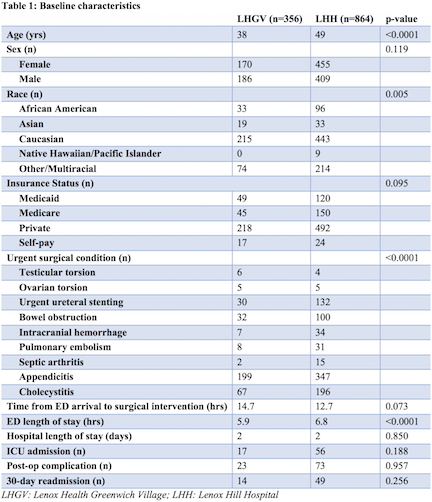
Introduction: Over the past decade, there has been a dramatic increase in the number of freestanding emergency departments (EDs) affiliated and located near existing hospital-based EDs. Given freestanding EDs do not have in-house surgical specialty providers, the purpose of this study was to determine whether differences exist in the quality of care and clinical outcomes of patients presenting to freestanding versus hospital-based EDs for urgent surgical conditions. Methods: Retrospective analysis of patients that presented to Lenox Health Greenwich Village (freestanding) and Lenox Hill Hospital (hospital-based) EDs in New York City between 01/2019 and 02/2021 with urgent surgical conditions was performed. Data collected include patient demographics, ED and procedure time data, principal diagnosis and procedure, and post-operative data. Statistical analyses include Mann-Whitney test, Chi square test, COX regression, and logistic regression, with p < 0.05 considered statistically significant. Results: 1220 patient were included in this study, with 356 presenting to freestanding and 864 to hospital-based ED for surgically urgent conditions, including testicular torsion (Table 1). Median times from ED arrival to surgical intervention were 14.7 hours in freestanding and 12.7 hours in hospital-based ED (p=0.073). Factors associated with significantly longer time intervals include African American race (HR=0.75, 95% CI:0.57-0.90), Medicaid (HR=0.80, 95% CI:0.68-0.95), and Medicare (HR=0.63, 95% CI:0.49-0.81). Patients who presented to freestanding ED had significantly shorter ED length of stay (p < 0.0001) and more accurate ED diagnoses (p=0.022). There were no statistical differences in ICU admission (p=0.188), post-operative complication (p=0.957), 30-day readmission (p=0.256), and mortality rates (p=0.524) between the two groups. Conclusions: Within our system, the quality of care and clinical outcomes of patients requiring urgent surgical intervention are comparable for those presenting to a freestanding ED versus a hospital-based ED. Thus, freestanding EDs in an urban environment may be beneficial for both patients and health care facilities. However, differences in care across race and insurance group must be further explored. SOURCE OF Funding: None