The Arthur Smith Institute for Urology, Northwell Health
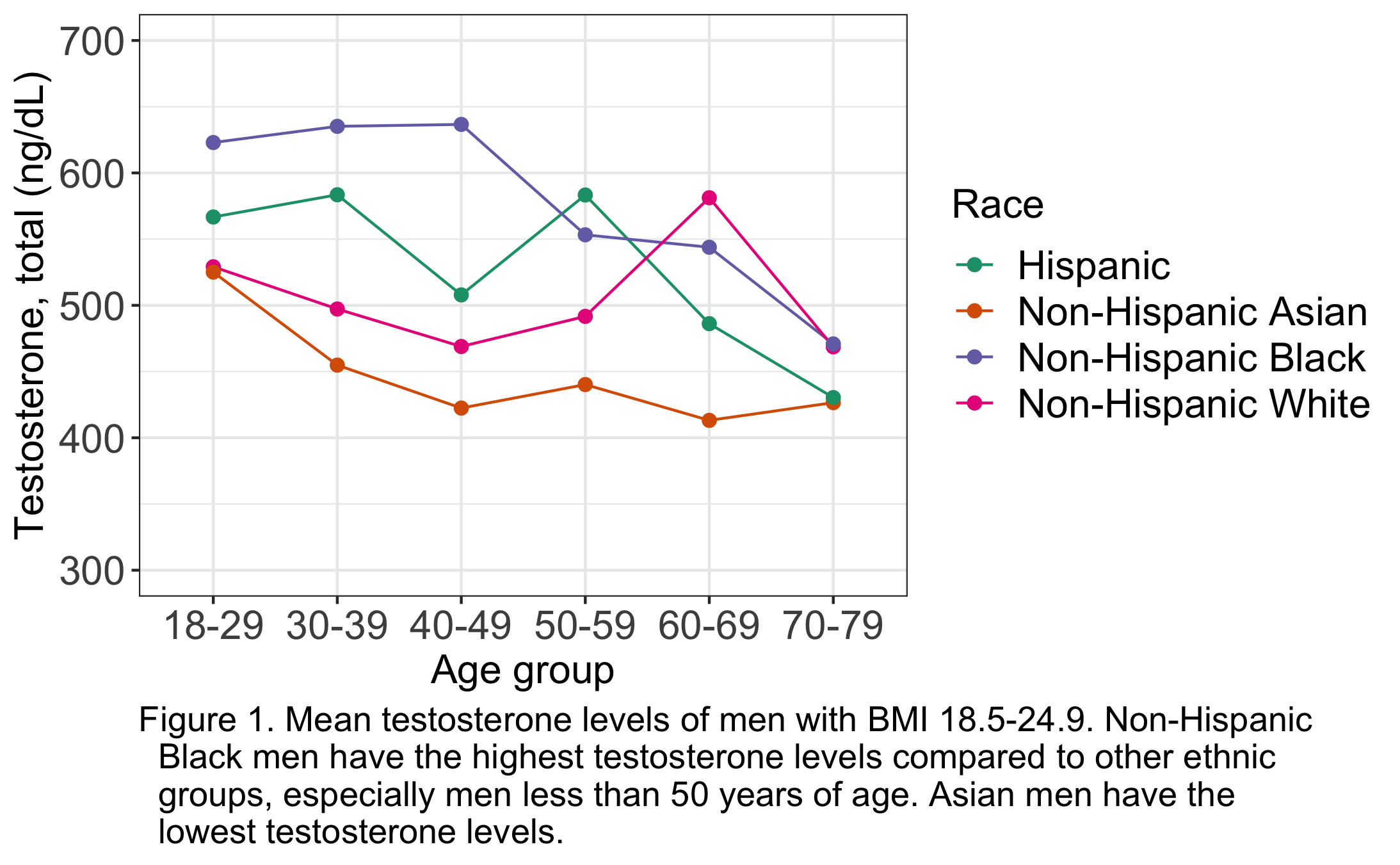
Introduction: Normal total testosterone (TT) levels are an area of significant controversy and are critically important in clinical care. Anecdotal evidence suggests that ethnicity may play a role in TT. We analyzed the National Health and Nutrition Examination Survey (NHANES) data to study the effects of ethnicity on TT levels using the recommended method of TT measurement. Methods: Data from the 2013-2016 NHANES survey were included. TT was measured using isotope dilution liquid chromatography-mass spectrometry certified by CDC Hormone Standardization Program. CDC's definition of race and ethnic groups was used. Only men 18-79 years old were included in the study. Men taking testosterone and aromatase inhibitors were excluded. Mean TT levels in each of the ethnic groups were compared using multivariate linear regression adjusting for the effect of ethnicity, age, BMI, DM, HTN, CAD, hypercholesterolemia, and smoking. Results: Of the 4,772 men, there were 1,824 Non-Hispanic Whites (NHW), 1,323 Hispanics (H), 606 NH Asians (NHA), and 1,019 NH Blacks (NHB). The median age for all groups was 46, with no significant differences in age between groups. The mean TT and 95%CI were 421 ng/dl (411-431) for NHW, 416 ng/dl (402-430) for H, 418 ng/dl (404-432) for NHA, and 457 ng/dl (444-471) for NHB. When adjusted for smoking, DM, hypercholesterolemia (HCL), BMI, and HTN, multivariate linear regression showed that NHB men had higher TT with an effect size of 30.63 (p < 0.001) while NHA men have lower TT with an effect size of -43.33 (p < 0.001) compared to NHW men. The differences in TT were more pronounced in men with normal BMI (18.5-24.9) aged 40-49; TT of NHB men was 637 ng/dL, compared to the TT of NHW men at 469 ng/dL (p < 0.01) (Fig 1). Conclusions: This is the largest study to date evaluating the effects of ethnicity on TT using the CDC-recommended method of testosterone measurements. NH Blacks have significantly higher TT levels even when controlling for age and comorbidities, while NH Asians have the lowest TT. The difference is most evident in Black men with a normal BMI age less than 50. This finding has important implications in clinical care and epidemiological studies. We recommend using ethnicity-specific TT levels, especially for NH Black men. SOURCE OF Funding: Fracchia Research Scholarship