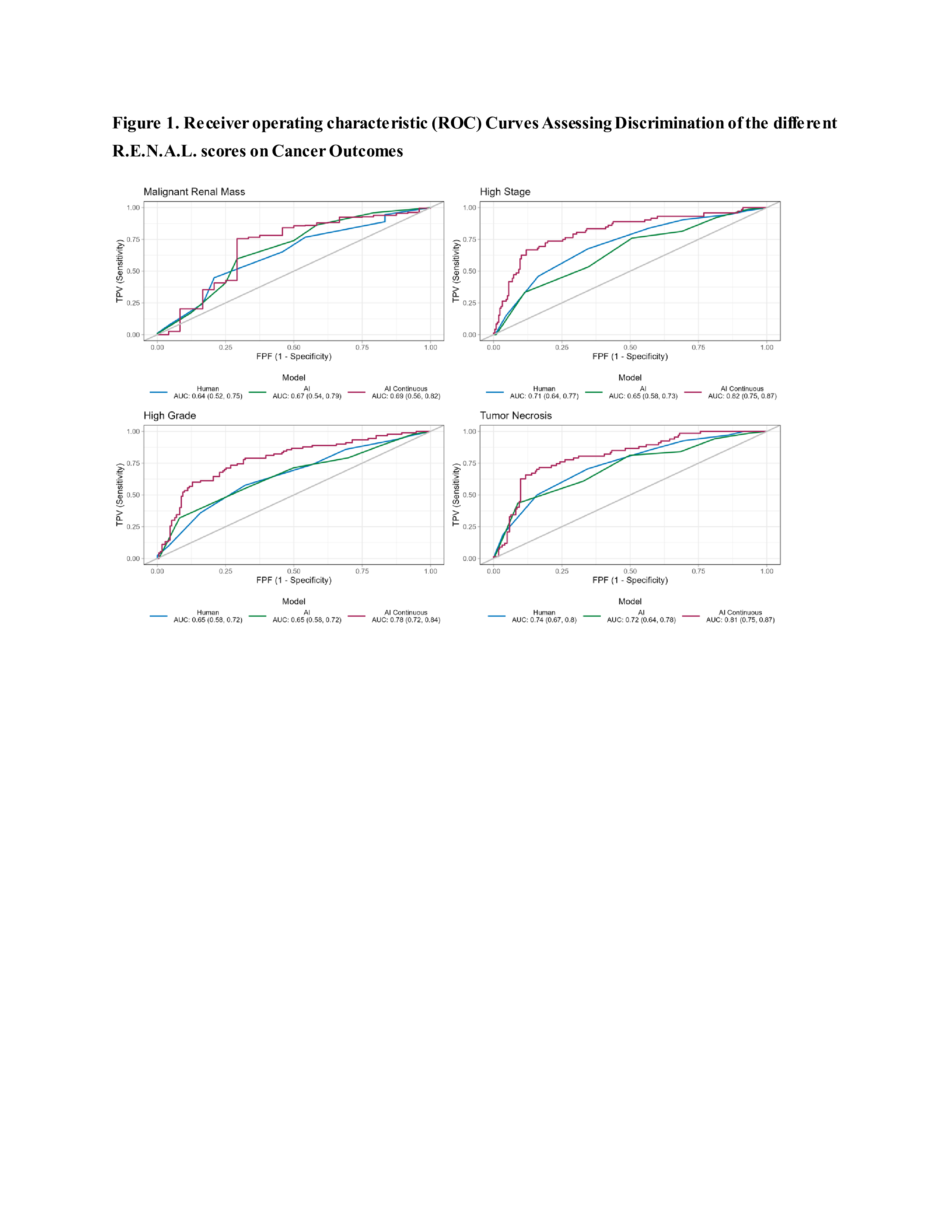
Introduction: The R.E.N.A.L. nephrometry score is a widely accepted surgical aid for extirpation of a renal mass. Excluding the tumor's location (anterior/posterior), the score categorizes variables that are otherwise continuous in nature to facilitate it. It has not yet been universally adopted at the point of care due to its ambiguity, time consumption, and interobserver variability. We previously showed that the artificial intelligence (AI)-generated R.E.N.A.L. score was non-inferior to the human-generated score in predicting perioperative and oncologic outcomes. We hypothesize that we can surpass the predictive ability of human-generated R.E.N.A.L. scores by creating an AI-generated R.E.N.A.L. score+ (AI+ score) with continuous variables rather than ordinal. Methods: We had 300 patients with preoperative computed tomography scan showing suspected renal cancer at a single institution. Human score was tabulated by 3 trained medical personnel blinded to AI-generated scores. Deep neural network approach was used to automatically segment kidneys into normal parenchyma and tumor, and geometric algorithms were used to estimate the score's components as continuous variables rather than ordinal. Operating characteristic curves (ROC) were created from logistic regression models, and areas under the curve (AUC) were compiled to evaluate the discriminatory ability of the AI+ score vs ordinally-derived AI and human-generated scores for the oncologic outcomes. We assessed the relative importance of the AI+ score components with respect to the odds of outcome through fit logistic regression models using standardized values. Results: The median age was 60 years (IQR 51-68), and 40% were female. The median tumor size was 4.2 cm (2.6-6.12), and 92% were malignant, including 27%, 37%, and 23% with high-stage, high-grade, and necrosis, respectively. The AI+ score had a superior discriminatory ability for each oncologic outcome, including the prediction of malignancy, high stage, high grade, and tumor necrosis (fig 1). The “R” component had the highest predictive odds ratio for oncologic outcomes. Conclusions: The AI+ score was superior in predicting meaningful oncologic outcomes compared to ordinal AI-generated and human-generated scores in a non-ambiguous time-efficient manner. SOURCE OF Funding: None