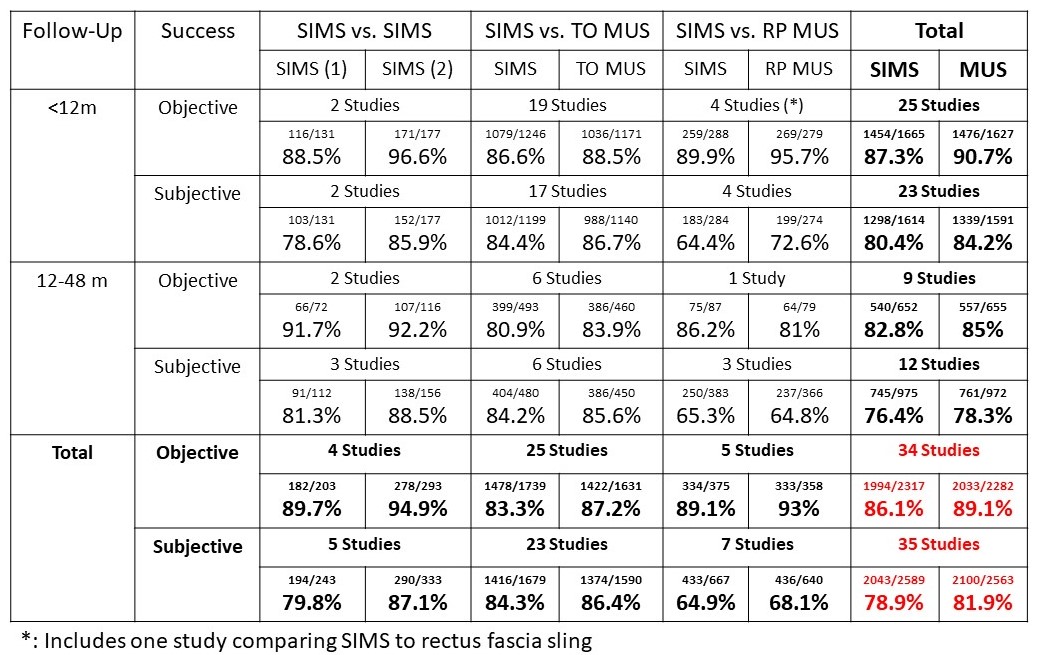
Introduction: The TVT-Secur, which comprised many of the randomized controlled trials (RCTs) in the 2017 Cochrane Review of single-incision minislings (SIMS), has since been withdrawn from the market. Our purpose is to review the emerging RCTs in which SIMS comprises at least one of the trial arms. Methods: A comprehensive PubMed search was performed, and several reviewers independently assessed the quality of the studies and extracted data. Study exclusion criteria included: abstract only, non-English language publication, minimum follow-up <6 months, and TVT-Secur as the sole other trial arm. A meta-analysis of surgical outcomes and adverse postoperative sequelae was performed. Results: Literature search yielded 31 unique data sets (research groups) and 43 RCTs. SIMS comprising at least one arm included: Ajust, Altis, Contasure Needleless, EFA, MiniArc, Ophira, TFS, and TVT-Abbrevo. While all studies were randomized, there was significant variation in study design, allocation concealment, blinding of outcome assessment, and handling of incomplete data sets. There was also significant variation in inclusion/exclusion criteria, outcome criteria, and adverse event reporting. In all, 2844 women had a SIMS in at least one study arm. Six studies either had a combination of two SIMS or two MUS in a trial arm, or two separate SIMS individually compared to one MUS. Objective and subjective outcomes stratified by length of follow-up and comparison device are summarized in the Table. Only one study reported outcomes at >48 months. Most of the comparisons were SIMS vs. transobturator midurethral slings (MUS), with only four data sets comparing SIMS and retropubic MUS. Overall, SIMS were non inferior to other MUS procedures and no one SIMS was associated with significantly better outcomes. Rates of de novo urgency and urgency incontinence, long-term pain, vaginal mesh exposure, and repeat surgery were low and were not significantly different between groups. Conclusions: Short- and medium-term results from RCTs suggest that SIMS are safe and non-inferior to other MUS. The majority of the comparisons are between SIMS and transobturator MUS and significant variations in study design make grouping of outcomes challenging. SOURCE OF Funding: None