Session: MP35: Stone Disease: Surgical Therapy (including ESWL) II
MP35-11: Trends and Incidence of Reported Events Associated With Ureteral Stents: An Analysis of the Food and Drug Administration's Manufacturer and User Facility Device Experience Database
Sant'Andrea Hospital, University LA SAPIENZA, Rome, IT
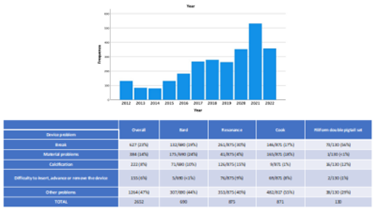
Introduction: To summarize medical device reports (MDRs) between 2012 and 2022 relating to ureteral stents within the Manufacturer and User Facility Device Experience (MAUDE) database maintained by The Food and Drug Administration (FDA). Methods: The MAUDE database was analyzed for all MDRs relating to each FDA-approved ureteral stents for the last ten years. Event descriptions were reviewed and characterized into specific event types. Outcome measures include specific ureteral stent and reported events as detailed by the MDRs. All data is de-identified and in compliance with the Health Insurance Portability and Accountability Act (HIPAA). No further data was available in the database. Data is presented as number of specific event/total events. Pooled Relative risk was used to compare data. Results: Overall, 2652 reports were retrieved in 10 years and a progressive rise in reported events was recorded (Figure1). Overall, 831/2652 (31%) were reported as injury while 1810/2652 (68%) as malfunction of the ureteral stent and 4 events of death. The most frequently reported AEs were stent break (627/2652:23%); material problems (384/2652: 14%); calcification (222/2652:8%); difficult to insert, advance or remove the device (155/2652: 6%). In terms of manufacturer: 875/2652 (33%) were Resonance stents, 871/2652 (33%) were Cook, 690/2652 (26%) were Bard and 130/2652 (5%) were filiform double pigtail ureteral stent set. Bard stents were associated with most material problems reports (19%), Resonance stents were associated with most difficulty to insert advance or remove the device (9%) and calcification (15%) while filiform double pigtail ureteral stent set were associated with most break reports (56%) when compare to the other stents (PRR>1, p<0,05)(Figure1). Conclusions: Standing to MAUDE database the most frequent complications related to ureteral stents are break, material problems, calcification and difficulty to insert, advance or remove the device. As well Resonance ureteral stents seem to be associated with a higher risk of device problems. SOURCE OF Funding: None