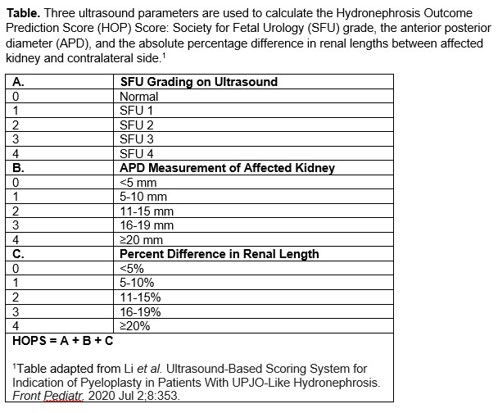
Introduction: For patients with isolated hydronephrosis and suspected ureteropelvic junction obstruction, diuretic renal scan (MAG-3) is one tool used for determining which patients may be obstructed. We sought to evaluate the Hydronephrosis Outcome Prediction (HOP) Score, which utilizes ultrasound measurements, for its association with obstruction based on MAG-3. Methods: Patients with prenatally detected and postnatally confirmed isolated hydronephrosis were prospectively enrolled from 7 centers from 2007-2022. Baseline ultrasounds were included if performed between 3 days to 6 months of life and with SFU grade, anterior posterior renal pelvis diameter (APD) and renal lengths available for analysis. Exclusion criteria were vesicoureteral reflux, primary megaureter, other urologic anomalies, and follow-up <3 months. The HOP score, adapted from Li et al,1 utilizes 3 ultrasound parameters: SFU grade, APD, and absolute percentage difference of renal lengths. HOP score was calculated on a 12-point scale with each parameter assigned a score from 0-4, 0 being least severe and 4 being most severe. Obstruction on MAG-3 was defined as T half-time =20 minutes and function <40%. Area under the curve and logistic regression were determined for association between HOP scores and MAG-3 results. Results: Of 1983 patients enrolled, 180 met inclusion criteria. Median HOP score was 8.0 (IQR 6-10) and median follow-up time was 34 months (IQR 22-48). Among the 19 (11%) patients with obstruction on MAG-3, the median HOP score was 9.0, while the remaining 161 patients had median HOP score of 8.0. HOP score =9 was the optimum threshold for predicting obstruction with AUC 0.67 (95% CI: 0.55-0.77). On logistic regression, patients with HOP score =9 at initial ultrasound were significantly more likely to have obstruction on MAG-3 (OR=3.8, 95% CI: 1.3-11, p=0.01). Overall, 92 (51%) of patients underwent pyeloplasty, while 25 (11%) resolved and 63 (35%) were under continued follow-up. Conclusions: We found that patients with HOP scores =9 on initial ultrasound were more likely to show obstruction on subsequent MAG-3. In combination with our previous study that showed HOP scores =4 are correlated with resolution, the HOP score is an accessible tool that predicts the outcomes of hydronephrosis from the initial postnatal ultrasound. SOURCE OF Funding: None