Resident Physician University of North Carolina, Chapel Hill
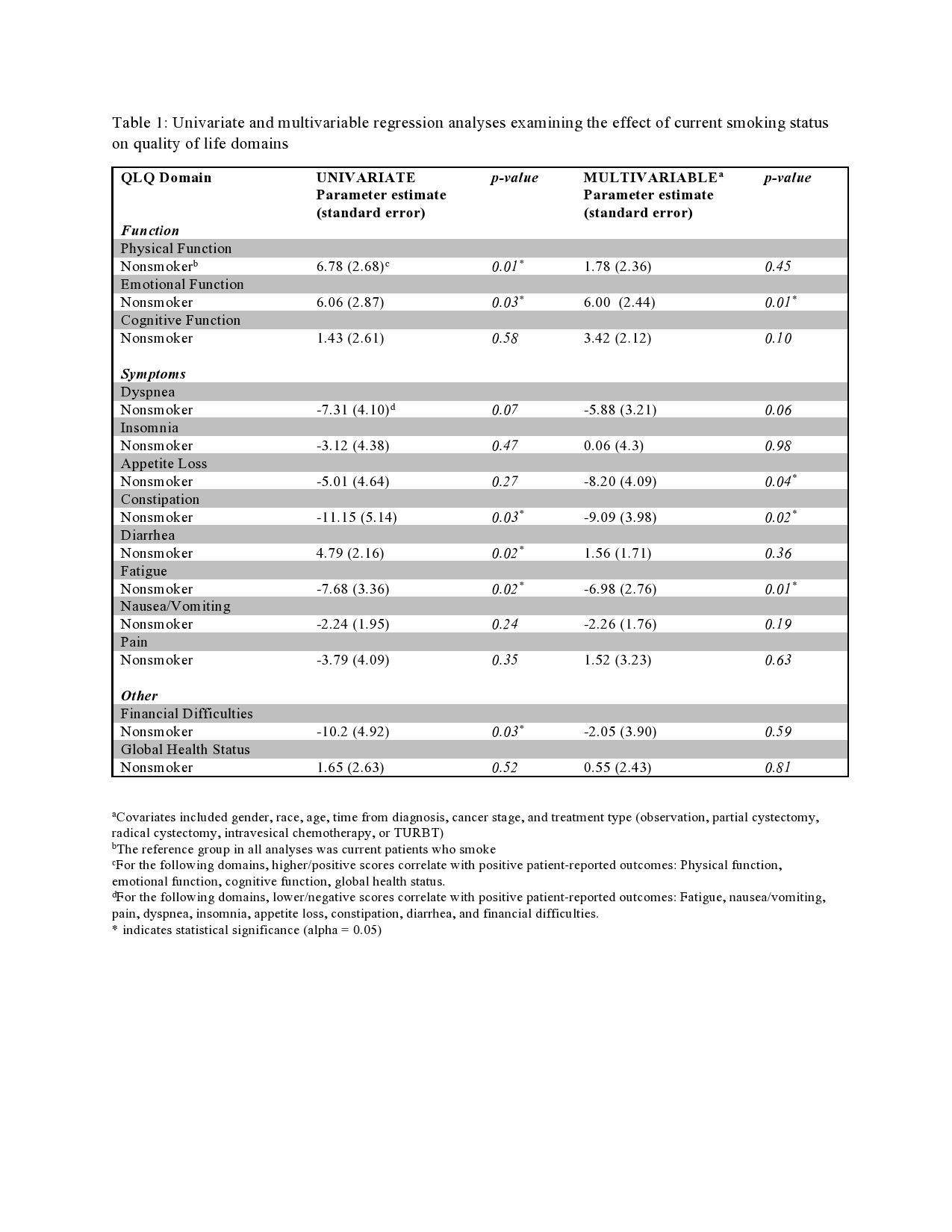
Introduction: Cigarette smoking is the most common risk factor for the development of bladder cancer. However, there is a paucity of data characterizing the relationship between smoking status and longitudinal Health Related Quality of Life (HRQoL) outcomes in bladder cancer patients. We sought to examine the association between current smoking status and HRQoL measures among bladder cancer patients following their cancer diagnosis. Methods: We performed a longitudinal, prospective study on a sample of patients aged =18 years diagnosed with bladder cancer in North Carolina from 2014-2015. The European Organization for Research and Treatment of Cancer (EORTC) Quality of Life Questionnaire core instrument (QLQ-C30) was administered at 3, 12, and 24 months after bladder cancer diagnosis. This questionnaire has been validated in diverse samples of cancer patients. The main exposure variable was current smoking status, assessed at 3, 12, and 24 months after bladder cancer diagnosis. We analyzed mean differences for each outcome between exposure groups with linear regression using Generalized Estimating Equations (GEE). Results: A total of 167 bladder cancer patients completed at least one survey. Of those, 154 participated in later surveys. A total of 125 patients who did not smoke completed surveys at 3, 108 at 12, and 86 at 24 months. A total of 28 patients who smoked completed surveys at 3, 23 at 12, and 25 at 24 months. Bladder cancer patients who smoked had significantly worse HRQoL measures in the domains of physical function (mean difference (MD) = 6.78, p < .05), emotional function (MD = 6.06, p < .05), fatigue (MD = -7.68, p < .05), and financial difficulties (MD = -10.20, p < .05). When controlling for time, stage, demographic covariates, and treatment type, emotional function (MD = 6.00) and fatigue (MD = -6.98) remained significantly different (Table 1). Conclusions: Bladder cancer patients who smoke have significantly worse HRQoL scores in the domains of physical function, emotional function, and fatigue. These results underscore the need to treat smoking as an essential component of bladder cancer care. Future work should implement smoking interventions that are directed at patient goals with respect to their unique values regarding life quality. SOURCE OF Funding: UNC Lineberger Comprehensive Cancer Center University Cancer Research Fund