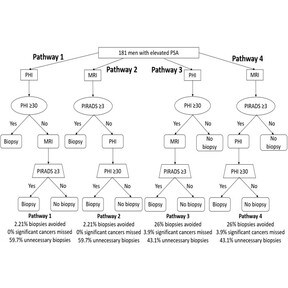
Introduction: To determine the optimal sequence of MRI and Prostate Health Index (PHI) as risk stratification tools in the early detection of prostate cancer. Methods: 181 men presented between Aug 2016 and Oct 2020, undergoing MRI and PHI before MRI-fusion biopsy. Biopsy included targeted and saturation cores. PIRADS score, PHI, and histology results were recorded. To determine the optimal sequence of MRI and PHI, modelling was performed with 4 pathways designed to guide biopsy decisions. PIRADS 3 or more, and PHI of 30 or more, were considered as screen-positive tests and patients proceeded with biopsy. The 4 pathways were: (1) PHI first then MRI to stratify PHI-negative cases; (2) MRI first then PHI to stratify MRI-negative cases; (3) PHI first then MRI to stratify PHI-positive cases; and (4) MRI first then PHI to stratify MRI-positive cases. For each pathway, the key outcomes measured were (1) the percentage of biopsies avoided, (2) clinically-significant cancers missed (Grade Group 2 and above); and (3) unnecessary biopsies (negative and Grade Group 1). Results: Overall cancer detection rate was 61.3%, and the clinically-significant cancer detection rate was 37.6%. 88.4% had a PIRADS 3 or higher lesion, and 82.9% had a PHI level of 30 or more. In Pathway 1, where PHI was used first-line, with MRI as second-line when PHI was negative, 2.21% of biopsies would be avoided, and no clinically-significant cancers would be missed. In Pathway 2, where MRI was used first-line, with PHI as second-line when MRI was negative, 2.21% of biopsies would be avoided, and no clinically significant cancers would be missed. In Pathways 3 and 4, 26% of biopsies were avoided, yet 3.9% of clinically-significant cancers would be missed (see Figure 1). Conclusions: The combination of PHI and MRI did not miss any clinically-significant cancers. This was only evident in the pathways where the second-line test was used in cases when the first-line test was negative. Whether PHI or MRI was sequenced as the first-line test did not affect the overall diagnostic performance in the detection of prostate cancer. We propose that MRI and PHI be combined to achieve the optimal screening performance for prostate cancer detection. SOURCE OF Funding: There are no sources of funding.