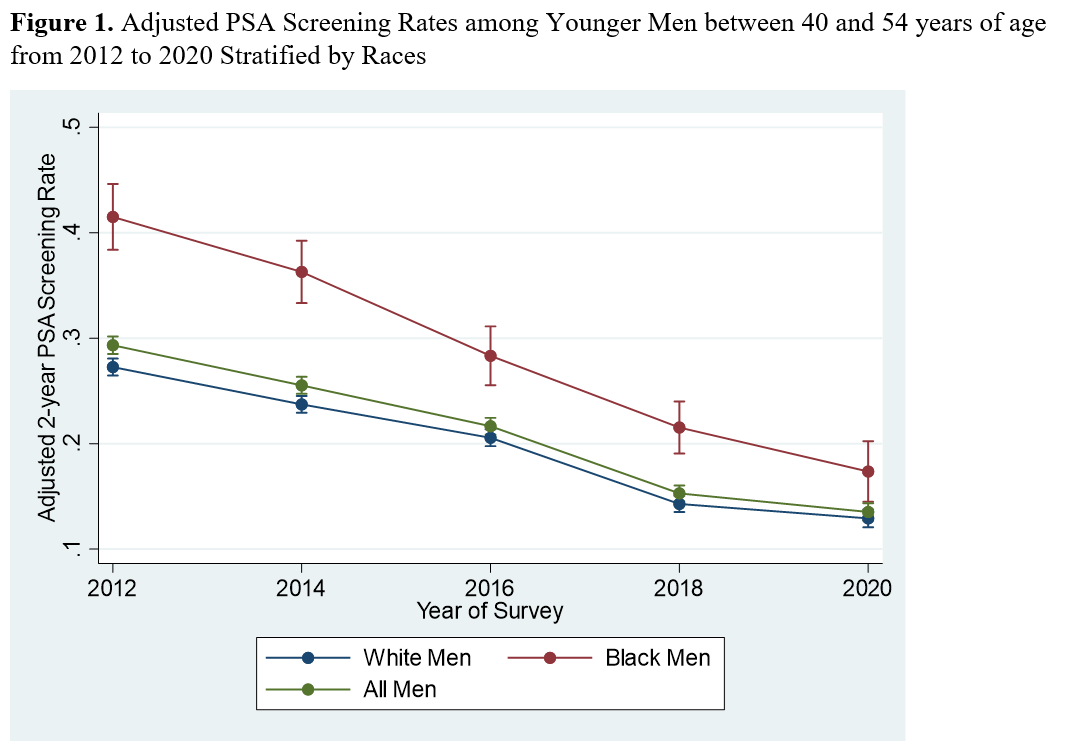
Introduction: 2012 US Preventive Services Task Force (USPSTF) guidelines recommended against routine screening for prostate cancer with Prostate Specific Antigen (PSA), which were modified in 2018 into shared decision making for men aged 55-70. While high-risk populations like black men may benefit from screening at earlier ages, USPSTF guidelines have consistently recommended against routine screening in younger men (aged 40-54). We studied the trends in PSA screening in younger black and white men following implementation of 2012 and 2018 guidelines. Methods: Younger men aged 40-54 years were identified in the Behavioral Risk Factor Surveillance System database from 2012 to 2020. Our primary outcome was PSA screening within two years of the survey. Primary independent variables were race and survey year. We fit adjusted multivariable logistic regression models to analyze the associations between race, survey year, and PSA screening. Effect modification by race and year was assessed using interaction terms. Subsequent marginal effect analyses were performed to compare the rate of change in PSA screening between white and black men throughout the study period. Results: A weighted total of 118,342,956 men were included. PSA screening decreased across both races from 2012 to 2020. Multivariable regression with analysis of marginal effects of interaction terms showed significantly lower odds of PSA screening among both younger white and black men in 2014, 2016, 2018, and 2020 compared to 2012 (OR= 0.77, 95%CI [0.62,0.96], 0.51, 95%CI [0.41, 0.63], 0.33, 95%CI [0.27, 0.42], 0.25, 95%CI [0.18, 0.32] for younger black men, and OR=0.81, 95%CI [0.76, 0.87], 0.66, 95%CI [0.61, 0.71], 0.41, 95%CI [0.37, 0.44], 0.36, 95%CI [0.33, 0.39] for younger white men). Significant interaction between race and year of survey was observed (p=0.02). Younger black men showed more rapid decrease in PSA screening in year 2016, 2018, and 2020 compared to younger white men (all p< 0.05). Conclusions: PSA screening among younger men aged 40-54 steadily decreased over the past decade since 2012 USPSTF guideline change, resulting in a narrowing of the screening gap between Black and White men. How this observed trend of rising guideline adherence translates to long-term clinical outcomes for younger black men remains to be seen. SOURCE OF Funding: None