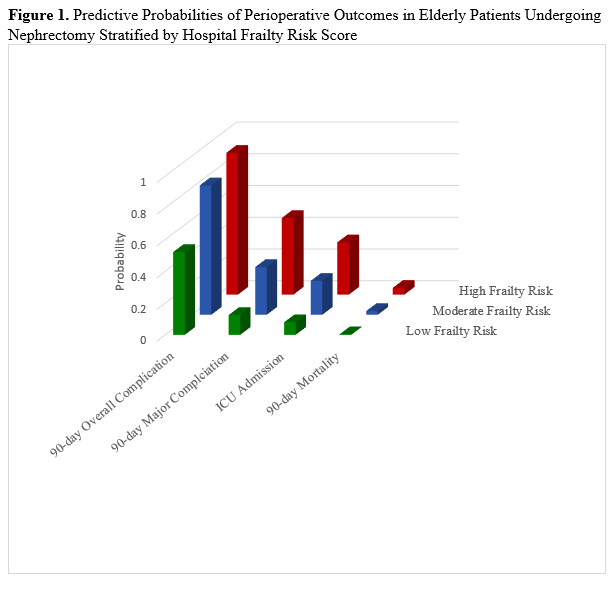
Introduction: The majority of kidney cancer is diagnosed after age 65. Risk stratification of elderly patients by frailty is an integral element of surgical decision making. Hospital Frailty Risk Score (HFRS) is a novel instrument based on 109 International Classification of Diseases-10 (ICD-10) diagnosis codes. It was devised in 2018 via rigorous validation with multi-institutional data in the UK and provides an efficient way of screening for frailty in elderly patients using data readily available from electronic medical records. We aimed to examine the ability of HFRS to predict perioperative outcomes among elderly patients undergoing nephrectomy. Methods: We identified patients over 65 years from the Premier Healthcare Database between 2016 and 2020 after the 2015 shift to ICD-10 coding. HFRS was calculated and stratified into low, moderate, and high frailty risks. Our primary outcomes were the odds of intensive care unit admission, 90-day overall complications, 90-day major complications, and 90-day mortality. We used separate multivariable logistic regression models to analyze each outcome of interest. Covariates adjusted for included age, sex, race, insurance, rural/urban location, region of residence, hospital size, teaching hospital status, minimally invasive technique, and partial or radical nephrectomy. Results: Our cohort included 28,566 elderly patients. 22,071 (77.2%) scored low frailty risk on HFRS. 6,086 (21.3%) and 409 (1.4%) scored moderate and high frailty risk. Patients with moderate and high frailty risks on HFRS exhibited increasing odds of intensive care unit admission (aOR = 3.3 95%CI [3.1, 3.6] and aOR = 6.3 95%CI [5.1, 7.8]), 90-day overall complications (aOR = 4.2 95%CI [3.9, 4.5] and aOR = 8.0 95%CI [5.7, 11.3]), 90-day major complications (aOR = 3.1 95%CI [2.9, 3.3] and aOR = 6.9 95%CI [5.6, 8.4]), and 90-day mortality (aOR = 6.6 95%CI [5.0, 8.7] and aOR = 12.4 95%CI [7.6, 20.1]). Figure 1 summarizes the predictive probabilities from these models. Conclusions: Higher HFRS frailty risk is associated with progressively worse short-term outcomes from nephrectomy. With one out of every seven elderly patients undergoing surgery being frail, HFRS offers a straightforward, effective, and contemporary means of pre-nephrectomy risk stratification. SOURCE OF Funding: n/a