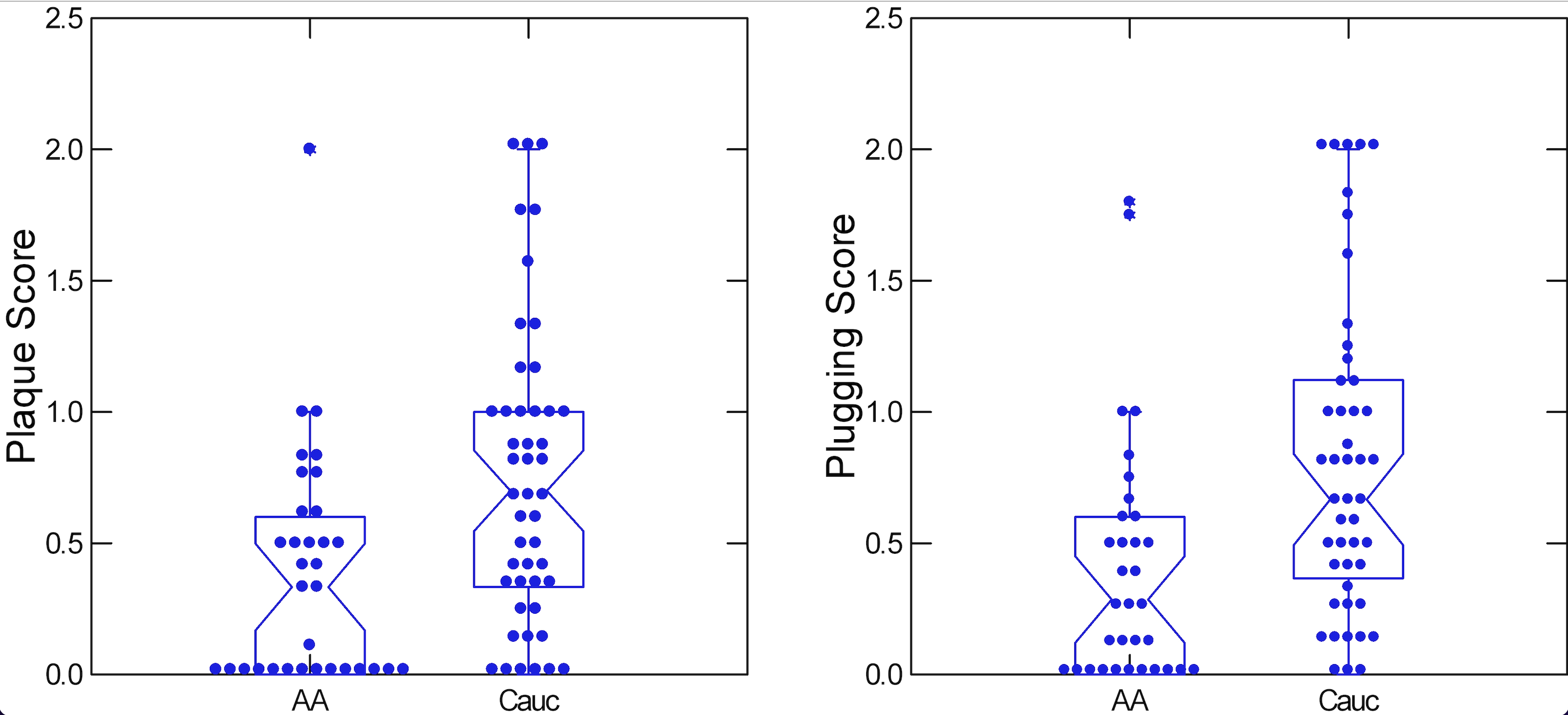
Introduction: Nephrolithiasis is common and incidence is increasing faster among Blacks (B) compared to Whites (W). Recent evidence suggests that many stone formers (SF) form calcium oxalate stones on the base of a Randall plaque (RP), but this has only been studied in W SF. We sought to compare the renal papillary anatomy of B and W to improve our understanding of stone pathogenesis in the two groups. Methods: SF undergoing ureteroscopy for the treatment of symptomatic and asymptomatic stone disease were prospectively enrolled. Patients with a systemic or anatomic cause for stone disease were excluded. Race was self-identified. Two blinded independent reviewers who had undergone standardized training on papillary grading used digital videos from ureteroscopy to assign scores of 0, 1 , or 2 for plugging, plaque, pitting, and loss of contour. Scores were averaged across all papillae graded per kidney for each category, as well as the combined total score, and compared using Mann-Whitney U test. ANCOVA models were used to evaluate differences in these scores with adjustments for sex, age, BMI, and recurrence status (RS). Results: Thirty-three B and 47 W patients were enrolled. Age was similar between groups but B had higher BMI (Table 1). The majority of patients were recurrent SF (66% W/83% B). B had significantly lower scores for plugging and plaque, as well as lower total scores (Table 1, Figure 1). In multivariate models, race was the only significant factor contributing to RP score, while race, age, and RS were significant for plugging. For total score, race and RS were significant contributors, and there was no interaction between race and RS. Conclusions: This study is the first to describe the papillary anatomy of B SF. Compared to W SF, B have significantly less RP and tubular plugging, suggesting potentially different mechanisms for stone formation. SOURCE OF Funding: P01 DK056788 (Worcester, Coe, Zisman)