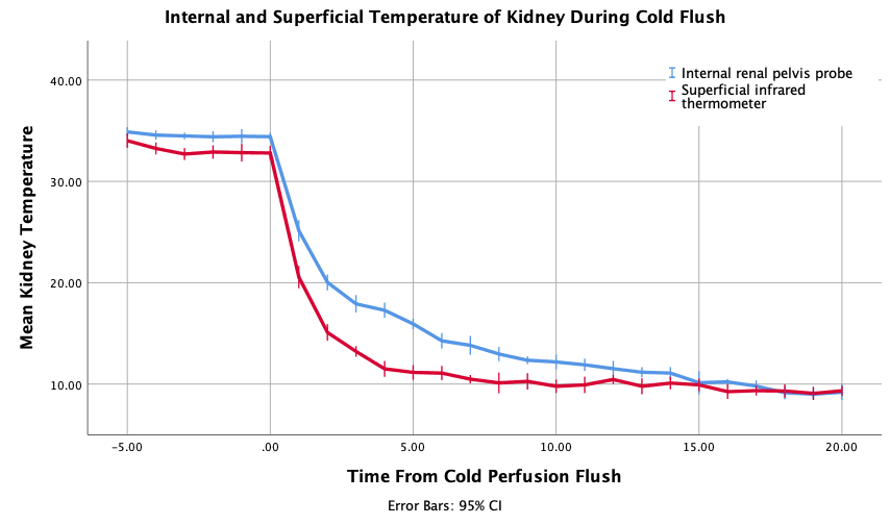
Introduction: Rapid cooling of kidney grafts after procurement surgery is essential to reducing organ storage injury. The technique to assess kidney temperatures has not been standardized. Invasive parenchymal probes have been used to measure internal temperature, while noninvasive methods such as surface probes or infrared thermometers only measure superficial temperatures. A ureteric probe inserted into the renal pelvis offers a noninvasive method of measuring the kidney’s internal temperature. We aimed to assess intrarenal kidney temperatures during simulated porcine kidney procurements. Methods: Six porcine kidneys underwent a simulated open donor nephrectomy. The kidneys were flushed with 4° C HTK solution, in a basin of cold saline with ice. Before flushing the kidney, a thermocouple was inserted retrograde through the ureter into the renal pelvis and connected to a portable vital signs monitor. The superficial temperature was taken using an infrared thermometer aimed at the lateral interpolar region of the kidney. Measurements were taken every minute, from 5 minutes prior to flush until 20 minutes after flush. SPSS was used for statistical analysis. Results: We saw a significant difference in temperature measurements between the intrarenal temperature probe and the superficial infrared thermometer. Inter-experimental differences were minimal. For the first 5 minutes after the flush, the intrarenal temperature had a mean of 19.2° C, while the superficial temperature was 14.3° C (p=0.001). Between 5 and 10 minutes, the intrarenal temperature had a mean of 13.1° C, while the superficial temperature was 10.3° C (p=0.002). Between 10 and 15 minutes, the intrapelvic temperature was 11.1°, while the superficial temperature was 10.0° C (p=0.012). However, temperature differences were not seen beyond 15 minutes post-flush. Conclusions: The ureteric probe measuring intrarenal temperature dropped slower than the superficial temperature measured with an infrared thermometer in our clinically relevant model. Beyond 15 minutes, superficial and internal temperatures were identical. These data provide a basis for temperature assessment in ongoing laboratory and clinical research with regard to optimizing temperatures for kidney preservation and protection prior to transplantation. SOURCE OF Funding: No disclosures