Session: MP30: Infertility: Epidemiology & Evaluation I
MP30-16: The additional effect of the sperm DNA fragmentation index to predict pregnancy in primary infertile couple undergoing medically assisted reproduction
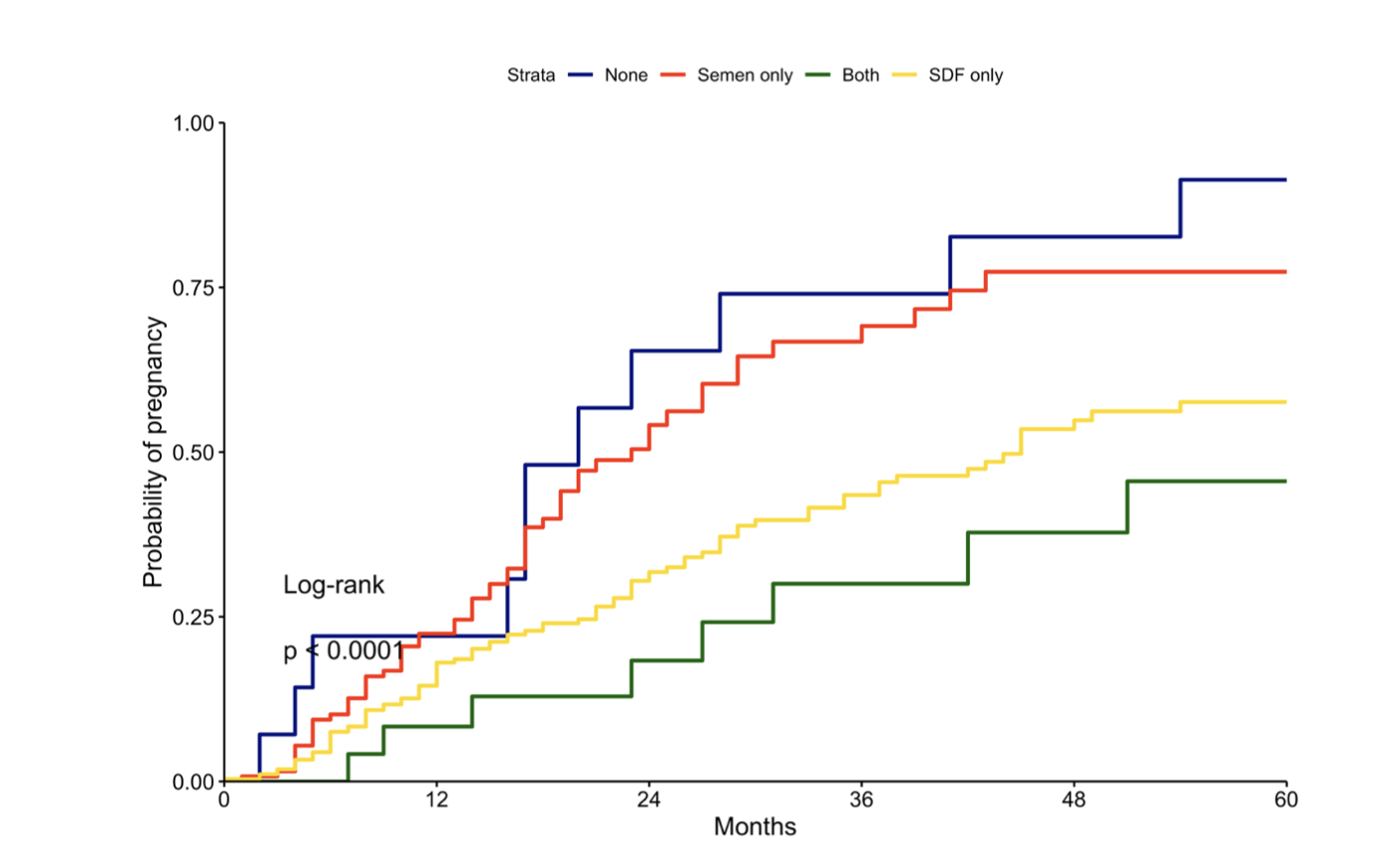
Introduction: To contextualize the role of sperm DNA fragmentation index (SDF) in primary infertile couple undergoing medically assisted reproduction (ART) Methods: Clinical and laboratory data, including semen analysis, SDF (pathological for SDF>30% according to SCSA) and serum hormones, from 442 white-European primary infertile couples associated with pure male factors and undergoing ART at a single tertiary-referral center were analyzed. Male infertile men were stratified in those having no alteration at seminal analysis, those having semen alterations, altered SDF only or both. Descriptive statistic was used to assess differences in baseline characteristics and cumulative incidence curves to show the probability of pregnancy with ART over time among the groups starting from the date at first presentation. Multivariable Cox regression analysis tested the effect of DFI alteration on pregnancy probability with ART Results: Of 442 patients, 14 (3.2%) had semen abnormalities, 130 (29.4%) semen abnormalities only, 24 (5.4%) had pathologic SDF only and 274 (62%) both semen and SDF abnormalities. No differences were found in terms of age at presentation, comorbidities, BMI and length of infertility (overall 18 months [12-32]) among the groups (p>0.05). The median number of cycles of ART before pregnancy or loss to follow-up was similar among group (overall 1 [1-2]). The most used ART approach was ICSI in 404 couples (91.4%). Overall, 189 couples obtained pregnancy in a median follow-up of 24 months (95%CI 23-30). Patients with no semen alteration and those with macroscopic seminal abnormalities had a higher probability of achieving pregnancy compared to those with SDF only or both parameters altered (p < 0.001) (Figure 1). At multivariable cox regression analysis, the hazard ratios (HR) for pathologic SDF only and for the combination of macroscopic semen abnormalities and pathologic SDF were 0.37 (95%CI 0.16-0.83; p=0.02) and 0.31 (0.20-0.67; p=0.001), respectively, after adjusting for age of male and female age, comorbidities, testosterone levels and BMI Conclusions: SDF emerged as a relevant clinical predictor throughout the male diagnostic work-up in primary infertile couples undergoing ART. Altered SDF increases of 60-70% the risk of unsuccessful ART cycles SOURCE OF Funding: None