
.jpg)
Caries

Kelsey O'Hagan-Wong, DDS
Paediatric dentistry resident
University of Toronto
University of Toronto
Toronto, Ontario, Canada
Joachim Enax, PhD
Research Department, Dr. Kurt Wolff GmbH & Co. KG
Bernhard Ganss, M.Sc., Ph.D.
Professor
University of Toronto, Faculty of Dentistry
Toronto, Ontario, Canada
Frederic Meyer, PhD
Dr. Kurt Wolff GmbH & Co. KG
Jill Oxner, BSc (Hons), DDS, MSc, Pediatric Dentistry, FRCD(C)
Assistant Professor
University of Toronto
Toronto, Ontario, Canada
Bernhard Ganss, M.Sc., Ph.D.
Professor
University of Toronto, Faculty of Dentistry
Toronto, Ontario, Canada
Purpose: The purpose of this in vitro study was to investigate the effect of amelotin-hydroxyapatite nanoparticles (AMTN-HAP) on the remineralization of enamel white spot lesions. Amelotin (AMTN) is a protein expressed during the maturation process of amelogenesis that has been found to be an important promoter in the mineralization and is a potential target in the development therapeutic strategies for caries control.
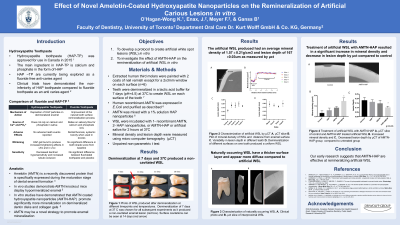
Methods: Healthy extracted human third molars were demineralized in a lactic acid buffer (pH= 4.5) for 7 days at 37 °C to create non-cavitated WSL. The demineralization profile of artificially induced WSL was compared to naturally occurring WSL. The WSL were either left untreated, treated with recombinant AMTN, hydroxyapatite nanoparticles (HAP), or AMTN-HAP for 2 hours. WSL were imaged using micro-CT and optical coherence tomography (OCT) and mineral density and lesion depth were the primary outcomes.
Results: The non-cavitated WSL lesions had an average mineral density of 1.57 +/- 0.21 g/cm3 and lesion depth of 167.76 +/- 0.03 um. Compared to naturally occurring WSL, the artificially induced WSL were more uniform in terms of mineral density and depth. Our preliminary results show that the application of AMTN-HAP to artificial WSLs produced a statistically significant increase in mineral density and a reduction in lesion depth compared to the control as measured by micro-CT.
Conclusion: AMTN-HAP may be a novel therapeutic strategy for the remineralization of WSL, particularly in high caries risk patients where the unintended ingestion of fluoride may pose a concern.