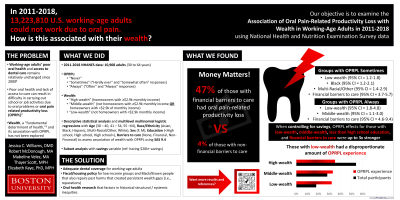
Objectives: To examine the association of oral pain-related productivity loss (OPRPL) with wealth in 10,908 working-age adults (30-64 years old) using 2011-2018 National Health and Nutrition Examination Survey (NHANES) data.
Methods: This cross-sectional study measured the association of oral pain-related productivity loss with wealth. The outcome variable, OPRPL, was categorized into “Never,” “Sometimes” (“Hardly ever” and “Somewhat often” responses) and “Always” (“Often” and “Always” responses). The exposure variable, wealth, was created using an existing methodology by Kailembo et al. This entailed combining and categorizing NHANES’ homeownership and family monthly income variables as low ( <$2900 monthly income/not homeowners), middle (≥$2900 monthly income/not homeowners or homeowners/ <$2900 of monthly income), and high-wealth (≥$2900 monthly income/homeowners). Using masked variance pseudo-primary sampling units and variables with a full sample 2-year mobile examination center exam weight for the 2011-2018 cycles, descriptive statistical analysis and multinomial logistic regression was used.
Results: Our weighted results found that between 2011-2018, 13,223,810 working-age adults in the US experienced OPRPL and those with low-wealth had 1.5 times the odds (95% CI = 1.2-1.8) of reporting OPRPL “sometimes” and 2.9 the odds (95% CI =1.8-4.8) of reporting OPRPL “always” compared to their high-wealth counterparts.
Conclusions: Expanding the lens of socioeconomic status to include factors that represent resources and generational wealth can enhance understanding of these dynamics as drivers of oral health outcome disparities.
Source of Funding: None
Affiliations: Boston University Henry M. Goldman School of Dental Medicine