Assisitant Professor University of Colorado Denver School of Dental Medicine, Colorado, United States
Abstract:
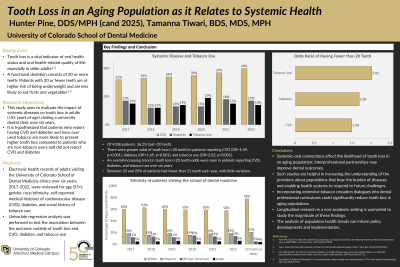
Objective: An understanding of population trends related to systemic and oral health is important for healthcare professionals to predict future outcomes and assist in healthcare assessment, service planning, and policy development. This study aimed to evaluate systemic oral health trends for the retention of natural teeth in adults 55 years and older.
Methods: Electronic health records of adults visiting the University of Colorado School of Dental Medicine clinics over six years, 2017-2022, were reviewed for age, gender, race/ethnicity, self-reported medical histories of cardiovascular disease (CVD), diabetes, and tobacco use. The primary outcome was the number of natural teeth present in the oral cavity ( < 20 teeth: yes/no). Univariate regression analysis was performed to test the association between the outcome variable and CVD, diabetes, and tobacco use.
Results: Of 4338 patients, 36.2% had < 20 teeth. There were greater odds of tooth loss ( < 20 teeth) in patients reporting CVD (OR=1.49, p< 0.001), diabetes (OR=1.69, p< 0.001), and tobacco use (OR=2.02, p< 0.001). An overall increasing trend in tooth loss ( < 20 teeth) odds were seen in patients reporting CVD, diabetes, and tobacco use over four years. An increasing trend in the percentage of adults with tooth loss was seen in tobacco users.
Conclusion: This study suggests evidence of systemic-oral connections over four years in older adults. Patients reporting CVD, diabetes, and tobacco use were more likely to have tooth loss, suggesting a need for interprofessional partnerships to address risk factors for poor dentition.
Source of Funding: None
Affiliations: University of Colorado School of Dental Medicine