Dental Public Health Resident Centers for Disease Control and Prevention, Texas, United States
Abstract:
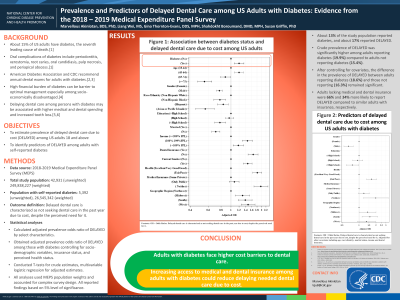
Objective: People with diabetes are less likely to use dental services although they may have more adverse health outcomes if needed dental care is forgone, e.g., leaving periodontal disease untreated can lead to poor glycemic control. This study estimates the prevalence of reporting forgone needed dental care due to costs (FORGONE) and associated risk factors among US adults.
Methods: We analyzed data for 43,291 adults who participated in the 2018 and 2019 Medical Expenditure Panel Surveys (MEPS). All analysis used sample population weights and accounted for MEPS complex sampling design. We used t-tests to compare crude estimates of FORGONE by diabetes status. Model-adjusted estimates were obtained using logistic regression that controlled for age, sex, race/ethnicity, education, marital status, income, medical/dental insurance, perceived health, and geographic region.
Results: Among the study participants in the 2018 and 2019 MEPS, 12 .6% and 16.8% self-reported diabetes and FORGONE, respectively. Crude prevalence of FORGONE was significantly higher among adults with diabetes (19.9%) compared to adults without diabetes (15.4%). After controlling for the covariates, the difference in FORGONE between adults with diabetes (18.6%) and without diabetes (16.3%) remained significant. Adults lacking medical and dental insurance were respectively, 66% and 34% more likely to report FORGONE than adults with insurance.
Conclusions: Adults with diabetes face higher cost barriers to dental care although some medial insurance covers select dental services. Increasing access to medical and dental insurance could reduce forgoing needed dental care.