Managing Partner Beckett Solar Energy Altadena, California, United States
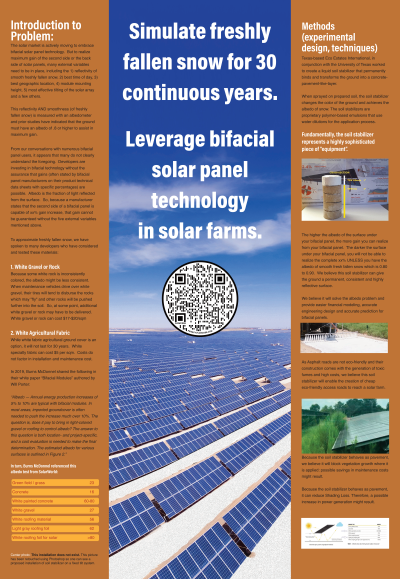
The solar market is actively moving to embrace bifacial solar panel technology. But to realize maximum gain of the second side or the back side of solar panels, many external variables need to be in place, including the 1) reflectivity of smooth freshly fallen snow, 2) best time of day, 3) best geographic location, 4) module mounting height, 5) most effective tilting of the solar array and a few others. This reflectivity AND smoothness (of freshly fallen snow) is measured with an albedometer and prior studies have indicated that the ground must have an albedo of .8 or higher to assist in maximum gain. From our conversations with numerous bifacial panel users, it appears that many do not clearly understand the foregoing. Developers are investing in bifacial technology without the assurance that gains (often stated by bifacial panel manufacturers on their product technical data sheets with specific percentages) are possible. Albedo is the fraction of light reflected from the surface. So, because a manufacturer states that the second side of a bifacial panel is capable of xx% gain increase, that gain cannot be guaranteed without the five external variables mentioned above. Also, currently roads going into and inside solar farms are made from toxic asphalt and climate-wrecking concrete. Using proven eco-friendly cost-effective products to replace toxic asphalt and climate-wrecking concrete pavements/roads will make the solar farm projects more green and part of the solution to reduce CO2 in the atmosphere.