Director Business Development FabTech Solar Solutions Gilbert, Arizona, United States
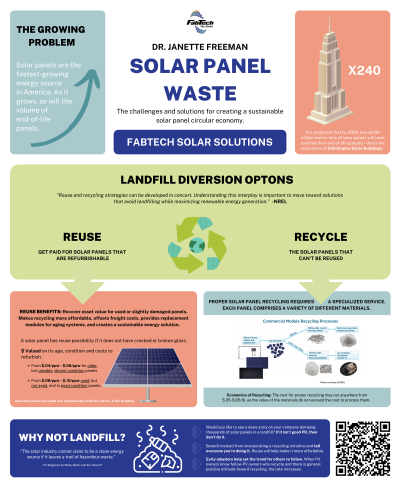
With solar panels having a life span of 20-30 years, many are starting to reach end-of-life. It is projected that by 2050, around 80 million metric tons of solar panels will have reached their end of life globally - that’s the equivalent of 240 Empire State Buildings. That is a huge amount of waste, and the challenge is that they are not easy or inexpensive to recycle, and landfilling is not only hazardous, it wastes valuable materials, all of which are needed to keep producing solar panels. This is an issue that affects everyone in the renewable energy field, either directly or indirectly if we claim to be the greener solution. Now is the time for solar developers and owners to have an end-of-life plan and an understanding of what that takes.
“Reuse and recycling strategies can be developed in concert. Understanding this interplay is important to move toward solutions that avoid landfilling while maximizing renewable energy generation.†-NREL
• Every solar project has different end-of-life point definitions. • Recycling Process and Economics Outlined • Reuse Possibilities. When is a solar panel at end-of-life? What qualifies a panel for reuse value? How much are they worth? • Reuse benefits: Listed are several benefits of reusing panels as an integral part of the circular economy. • Why not landfill? How would you, as a leader in the clean energy industry, feel about a news story on your company dumping thousands of solar panels in a landfill? If it isn’t good PR, then don’t do it. Benefit instead from incorporating a recycling initiative, and tell everyone you’re doing it. Reuse will help make it more affordable. • Early adopters help set the trend for others to follow. When PV owners know fellow PV owners who recycle and there is general positive attitude toward recycling, the rate increases. Social influence could be our greatest influencer.