Owner poweringaplanet.com Fort Collins, Colorado, United States
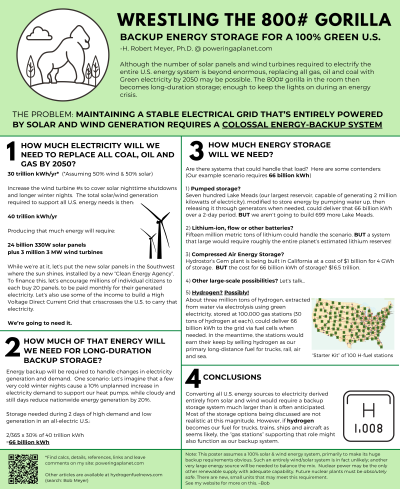
Even though enormous quantities of solar panels and wind turbines will be necessary to electrify a U.S. with all coal, oil and natural gas combustion terminated, enough panels and turbines could be operating by 2050 to do the job. Given that possibility, the 800# gorilla to be wrestled becomes long-duration storage sufficient to power large portions of the country during inevitable high-usage/low-generation emergencies. Terawatt-hours at the ready to cover the cold, still nights, grid failures and Old Man Winter’s vicissitudes. While ever-more-capable battery storage is coming, there isn’t an obvious future where batteries (or most other options currently on the table) could power a fully electrified U.S. region for days of severe shortage. While we’re waiting for that orders-of-magnitude miracle, the solar and wind energy sources now being installed must be properly backed up to avoid destabilizing the grid. This should be a continuous process -- each new gigawatt of clean energy should be complemented by enough storage to prevent blackouts. If, as seems likely, hydrogen becomes the dominant long-distance fuel for trucks, trains, ships and aircraft, produced by electrolysis of water at thousands of fueling stations throughout the country, it could potentially handle this immense backup problem. Hydrogen could be stockpiled at increasing numbers of H-fuel stations as green electricity replaces conventional generation. Much of the installation cost would be amortized via transportation-fuel profits. Extra hydrogen storage capacity, plus fuel cells to produce the backup electricity, could be financed by a region’s electric utilities. Other ways to wrestle the storage gorilla may eventually surface, but the hydrogen technology to support this solution is available now.