Student William James College Brighton, Massachusetts, United States
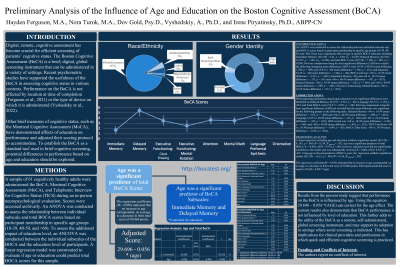
Objective: Remote cognitive assessment is increasingly common for efficient screening of patients' cognitive status. The Boston Cognitive Assessment (BoCA), is a brief, digital, global screening instrument that can be administered in-person or remotely. To evaluate the psychometric properties of the BoCA, the present study explored the effect of age and education on performance.
Method: A sample of 61 cognitively healthy adults (19-82 years old) with 12-20 years of education completed the BoCA in-person. BoCA performance is rated along eight subscales (Immediate Recall, Delayed Recall, Visuospatial, Executive Functioning, Mental Rotation, Attention, Language, Mental Math, and Orientation) with a total score of 30. A regression analysis assessed if age or education predicted BoCA scores. BoCA performance was evaluated based on age with and without adjusting for educational attainment.
Results: The regression analysis yielded a significant model with age being a significant predictor of total BoCA scores. Education did not contribute significantly. An ANOVA based on age revealed a significant effect on the Total BoCA score and specific subscales (Immediate and Delayed Memory). When adjusting for educational attainment, an ANCOVA identified significant differences within the total BoCA score and subscales of Delayed Memory and Language.
Conclusions: After correcting for level of education, results from the present study suggest that participants' age does affect the total BoCA score of cognitively healthy users. This has implications for future BoCA users, as age-adjusted scores may be necessary to prevent false positive identification of cognitive impairment using the BoCA. Potential explanations for discrepancies among age groups are discussed.