Doctoral student University of South Alabama Mobile, Alabama, United States
Objective: Demographic correction of cognitive data is being increasingly scrutinized. We compared phonemic fluency for African Americans and Caucasians using three normative systems.
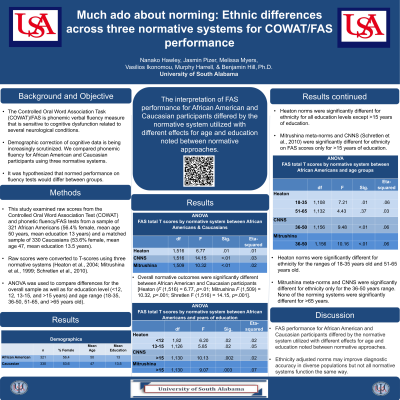
Methods: Controlled Oral Word Association Test (COWAT)/FAS raw scores for 321 African Americans (56.4% female, mean age 50 years, mean education 13 years) and a matched sample of 330 Caucasians (53.6% female, mean age 47, mean education 13.5 years) were converted to T-scores using three normative systems (Heaton et al., 2004; Mitrushina et al., 1999; Schretlen et al., 2010). ANOVA was used to compare differences for the overall sample as well as for education level ( < 12, 12, 13-15, and >15 years) and age range (18-35, 36-50, 51-65, and >65 years old).
Results: Normative outcomes were significantly different between African American and Caucasian participants [Heaton (F (1,516) = 6.77, p=.01; Mitrushina F (1,509) = 10.32, p=.001; Shretlen F (1,516) = 14.15, p=.001]. Heaton norms were significantly different for ethnicity for all education levels except >15 years of education. Mitrushina meta-norms and CNNS (Schretlen et al., 2010) were significantly different for ethnicity on FAS scores only for >15 years of education. Heaton norms were significantly different for ethnicity for the ranges of 18-35 years old and 51-65 years old. Mitrushina meta-norms and CNNS were significantly different for ethnicity only for the 36-50 years range. None of the norming systems were significantly different for >65 years.
Conclusions: The interpretation of FAS performance for African Americans and Caucasians differed by the normative system utilized with different effects for age and education noted between normative approaches.