Project Director PAR Inc Washington, District of Columbia, United States
Objective: The Behavior Rating Inventory of Executive Function (BRIEF) captures perceptions of an individual’s executive functioning in their everyday environment. Two self-report forms span late adolescence into early adulthood: BRIEF2 (ages 11-18) and BRIEF-Adult (ages 18-90). We compared responses on these forms in young adults to evaluate their continuity in this transitional age range.
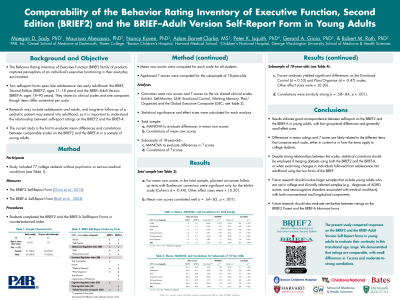
Method: Participants were 77 college students [age M(SD)= 18.45(0.64), 66% female], without psychiatric or serious medical conditions, who completed the BRIEF2 and BRIEF-A forms in counterbalanced order. Mean scores on shared clinical scales (Inhibit, Self-Monitor, Shift, Emotional Control, Working Memory, Plan/Organize) and Global Executive Composite (GEC) were examined using MANOVA and correlations; T scores were examined in the subsample of 18-year-olds (n=47).
Results: For mean ratings, planned univariate follow-up tests with Bonferroni correction were significant only for the Inhibit scale [F(1,76) = 14.69, p < .001, Cohen’s d = -0.44]. Other effect sizes were < 0.3. Scales correlated well (r range .63 to .82, p < .001). T-score analyses yielded similarly strong relationships (r range .58 to .84), but with significant differences on Emotional Control (d = 0.53) and Plan/Organize (d = -0.47).
Conclusions: Results indicate good correspondence between self-report on the BRIEF2 and BRIEF-A in young adults, with few differences and generally small effect sizes. Nonetheless, statistical corrections should be employed if merging datasets using both BRIEF2 and BRIEF-A, or when examining changes in individuals followed from adolescence into adulthood using the two forms of the BRIEF.