MS Student Rosalind Franklin University of Medicine and Science North Chicago, Illinois, United States
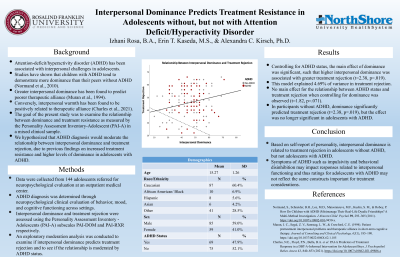
Objective: Attention-deficit/hyperactivity disorder (ADHD) has been associated with interpersonal challenges in adolescents. Greater interpersonal dominance has been found to predict poorer therapeutic alliance in adolescents, but previous work has not examined a potential moderating impact of ADHD. The goal of the present study was to examine the relationship between dominance and treatment resistance as measured by the Personality Assessment Inventory-Adolescent (PAI-A) in a mixed clinical sample.
Method: Data were collected from 144 adolescents referred for neuropsychological evaluation (M=15.27 years, Range=12-19, 41.0% female, 47.9% diagnosed with ADHD). ADHD diagnosis was determined through neuropsychological clinical evaluation of behavior, mood, and cognitive functioning across settings. Exploratory moderation analysis was conducted to examine if interpersonal dominance predicts treatment rejection and to see if the relationship is moderated by ADHD status.
Results: Controlling for ADHD status, the main effect of dominance was significant, such that higher interpersonal dominance was associated with greater treatment rejection (t=2.38, p=.019). No main effect for the relationship between ADHD status and treatment rejection when controlling for dominance was observed. In participants without ADHD, dominance significantly predicted treatment rejection (t=2.38, p=.019), but the effect was no longer significant in adolescents with ADHD.
Conclusion: Based on self-report of personality, interpersonal dominance is related to treatment rejection in adolescents without ADHD, but not adolescents with ADHD. Symptoms of ADHD such as impulsivity and behavioral disinhibition may impact responses related to interpersonal functioning and thus ratings for adolescents with ADHD may not reflect the same constructs important for treatment considerations.