Graduate Student Fairleigh Dickinson University Hillside, New Jersey, United States
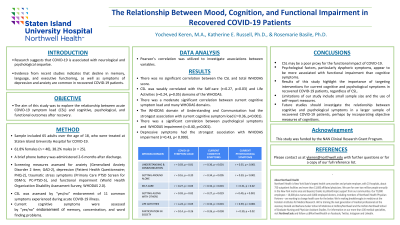
Objective: Recent studies exploring the psychological and cognitive effects of COVID-19 indicate decline in memory, language, and executive functioning, as well as symptoms of depression and anxiety. The objective of this study was to determine the relationship between acute COVID-19 symptom load and self-report of psychological, cognitive, and functional outcomes after recovery.
Method: 65 adults treated by Staten Island University Hospital for COVID-19 participated in a brief battery of screening measures. The protocol included the Generalized Anxiety Disorder-2, Patient Health Questionnaire-2, Primary Care PTSD Screen for DSM-5, and World Health Organization Schedule Disability Assessment Schedule 2.0 (WHODAS). Participants were asked about 11 symptoms they may have experienced when acutely ill to determine the total COVID-19 symptom load (CSL) and current cognitive and psychological symptoms. Pearson’s correlation was used to investigate associations between variables.
Results: CSL was not associated with total WHODAS score, although it was weakly associated with the Self-Care and Life Activities domains. Current cognitive symptom load was moderately associated with most WHODAS domains. It was most strongly associated with Understanding and Communication (r=0.36; p=0.003). All psychological domains were associated with greater WHODAS impairment, and depression had the strongest association (r=0.43; p< 0.001).
Conclusions: CSL does not appear to predict the functional impacts of COVID-19. Psychological factors, particularly depression, appear to be slightly more associated with functional impairment than cognitive symptoms. Results highlight the importance of targeted intervention for current cognitive and psychological symptoms in recovered COVD-19 patients, regardless of CSL.