Coordinator, Digital Product Design and Psychometrics Psychological Assessment Resources, Inc. Lutz, Florida, United States
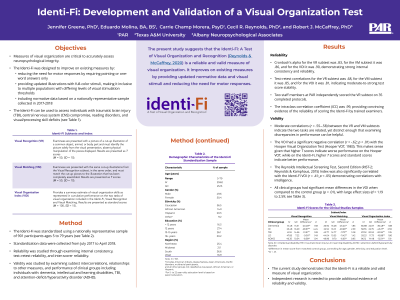
Objective: Visual organization measures are critical to assess accurately neuropsychological integrity. The Identi-Fi was developed to improve upon existing measures of visual organization by providing updated norms, updated visual stimuli, and reducing the need for motor responses.
Method: The Identi-Fi requires examinees to recognize illustrations which have been cut up and rearranged in the stimulus book. It consists of two subtests: Visual Recognition and Visual Matching, comprising the Visual Organization Index (VOI). The Identi-Fi was standardized utilizing a nationally-representative sample of 901 participants, aged 5 to 79 years. Multiple lines of reliability and validity evidence were examined.
Results: Cronbach’s alpha for the VOI was .90; the test-retest correlation was .81. The VOI had a significant negative correlation (r = -.62; p < .01) with Hooper Visual Organization Test (VOT). This was expected given the similarity in construct and that on the Hooper VOT, higher T scores indicate worse performance, while on Identi-Fi, higher T scores and standard scores indicate better performance. The Reynolds Intellectual Screening Test, Second Edition (RIST-2) Index was also significantly correlated with the Identi-Fi VOI (r = .41) demonstrating correlations with intelligence (p < .05). All clinical groups observed significant mean differences on the VOI compared to the control group (p < .01) with the largest effect sizes for the intellectual disability (d = 2.59) and dementia (d = 1.88) groups.
Conclusion(s): Evidence suggests Identi-Fi provides a reliable and valid measurement of visual organization when used as described. Independent research is sought for additional evidence.