Student Nova Southeastern University - Pembroke Pines, Florida, United States
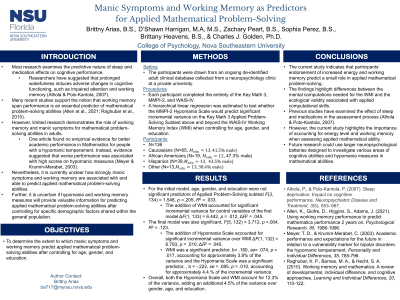
Objective: To determine the extent to which manic symptoms and working memory predict applied mathematical problem-solving abilities after controlling for age, gender, and education.
Method: Data was selected from an ongoing de-identified database of clinical adults. The sample chosen (N=136) comprised of mixed psychiatric adults consisting of Caucasians (N=65, M_edu=13,41.5% male & 58.5% female), African Americans (N=19, M_edu=12, 47.3% males & 52.7% females), Hispanics (N=39, M_edu=13,43.5% male & 56.5% female), and Other (N=13, M_edu=13,38.4% male & 61.6% female). All participants were administered the Key Math 3 Applied Problem-Solving Subtest, MMPI-2 Hypomania Scale, and WAIS-IV Working Memory Index (WMI).
Results: The WAIS-IV WMI was a significant predictor accounting for approximately 3.8% of the variance and the Hypomania scale was a significant predictor, accounting for approximately 4.4% of the incremental variance. Overall, both the hypomania scale and WMI account for 12.3% of the variance, adding an additional 4.5% of the variance over gender, age, and education.
Conclusions: The results indicate that participants’ endorsement of increased energy and working memory predict a small role in applied mathematical problem-solving. The findings highlight differences between the mental computations needed for the WMI and the ecological validity associated with applied computational skills. Previous studies have examined the effect of sleep and medications in the assessment process. The current study highlights the importance of accounting for energy level and working memory when assessing applied mathematical ability.