Doctoral Student The University of Texas at Tyler Fort Worth, Texas, United States
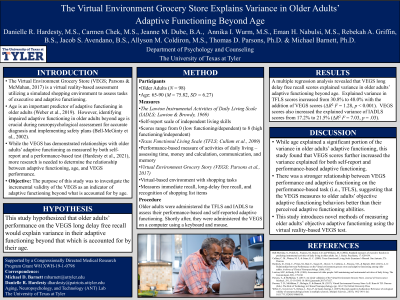
Background: The Virtual Environment Grocery Store (VEGS; Parsons & McMahan, 2017) has demonstrated relationships with older adults’ adaptive functioning as measured both by self-report and with a performance-based test (Hardesty et al., 2021). However, age is an important predictor of adaptive functioning among older adults (Weber et al., 2019). The purpose of this study was to investigate the incremental validity of the VEGS. We hypothesized that the VEGS long delay free recall would explain variance in adaptive functioning beyond that which is accounted for by age.
Method: Older adults (n = 98; age 65-90, M = 75.82, SD = 6.27) were administered the Virtual Environment Grocery Store (VEGS) and the Texas Functional Living Scale (TFLS) and completed the Instruments of Daily Activities Scale (IADLS) Questionnaire.
Results: Age explained 30.8% of the variance in TFLS. Inclusion of the VEGS long delay free recall meant that the model was able to explain 48.0% of the variance (R2 change F = 1.28, p < 0.001). Age explained 17.2% of the variance in IADLS scores; the inclusion of the VEGS long delay free recall brought this to 21.5% (R2 change F = 7.03, p = .03).
Conclusion: Among older adults, age is an important predictor of adaptive functioning as measured by self-report and performance-based test. The VEGS was able to explain substantial variance in older adults’ adaptive functioning beyond age, particularly when measured with a performance-based test. These results are consistent with the notion that the VEGS measures abilities relevant to older adult’s daily functioning.