Doctoral Psychology Intern Pacific University - Oregon Hillsboro, Oregon, United States
Objective: Investigate the association of white-matter hyperintensities (WMH) on routine clinical MRI and neuropsychological test performance in a young adult clinical sample referred for neuropsychological assessment.
Method: From a sample of 607 patients that underwent comprehensive neuropsychological evaluation, two groups were selected based on MRI results: 1) normal (n = 50 (30 females), Mage = 46.20, Medu = 15.16) and 2) WMH without other MRI abnormality (n = 35 (20 females), Mage = 47.83, Medu = 14.24). Exclusion criteria included dementia, other brain neuropathology (e.g. stroke, neurodegeneration, traumatic brain injury, multiple sclerosis, etc.), below normal scores on performance validity tests, and age > 59 years.
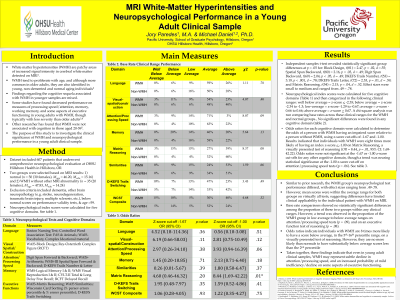
Results: Independent samples t-tests revealed statistically significant group differences for: Block Design (d=.55), Digit Span Backward (d=.49), Spatial Span Backward (d=.49), DKEFS Trails Number (d=.78), DKEFS Trails Letter (d=.59), and Matrix Reasoning (d=.52); although, means for both groups were within the average range for all neuropsychological tests.
Using logistic regression analyses, odds ratios were calculated for a person with WMH having an impaired index score using two z-score cut-offs: -1.67 and -1.00. WMH were associated with an index z-score < -1.00 on Matrix Reasoning (OR = 8.44, 95% CI: 1.69-42.22). A trend was near statistical significance (p= .06) at the -1.00 z-score cut-off on attention/processing speed tests (OR = 3.19, 95% CI: .93-16.39). Results for -1.67 cut-off were not significant.
Conclusions: These findings indicate that even in younger adults, WMH are associated with increased probability of mild inefficiency/decline in problem-solving/reasoning, and may be associated mild decline in attention/processing speed.